

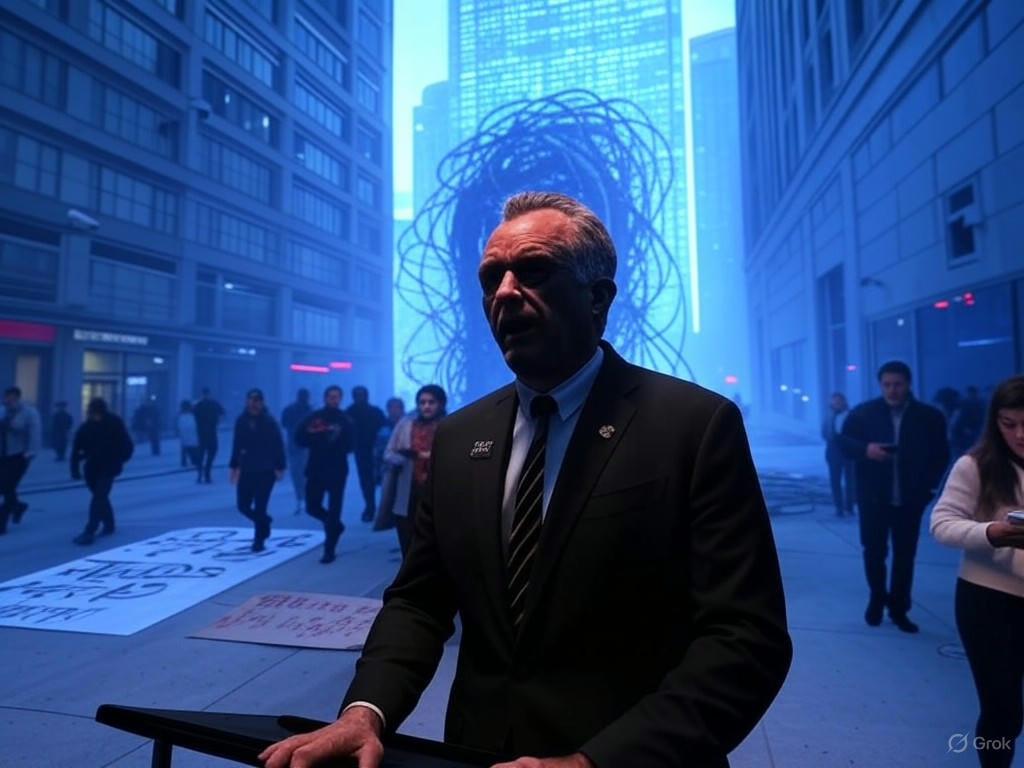
What’s with political campaigns and the shiny new toys they just can’t seem to resist. Robert F. Kennedy Jr.‘s team recently dipped their toes into the slightly murky waters of AI-generated imagery, and well, things got a bit wobbly. It wasn’t a grand, strategic move that changed the political landscape; it was, frankly, a bit of a stumble, like tripping over your own shoelaces while trying to look cool. And it raises a fascinating question: when does the whiz-bang promise of AI technology become just… weird?
When AI Gets a Bit Too Arty (and Creepy)
So, what happened? The RFK Jr campaign was putting out some merchandise, specifically a t-shirt. Standard stuff, right? Political campaigns love a good t-shirt. But instead of using a photograph of actual supporters, they opted for an AI generated image. And not just any AI image – one that, frankly, looked like it had melted slightly. The picture featured a group of people, supposedly representing the diversity of the campaign’s base, but their faces were distorted, eyes were a little off, and there was that general uncanny valley feel that early AI generated images often have. It quickly became the subject of a minor RFK Jr merchandise controversy. People noticed. How could they not? The image looked synthetic, unnatural, and slightly unsettling. This wasn’t just a blurry photo; it was a deliberate creation that missed the mark entirely, showcasing significant AI image distortion.
The backlash was swift, albeit perhaps contained within the online sphere for the most part. Social media lit up with comments pointing out the bizarre look of the image. This wasn’t the authentic representation the campaign likely hoped for. Instead, it highlighted the artificiality, turning what should have been a symbol of genuine support into a talking point about creepy tech fails. The RFK Jr merch image became an example of what *not* to do when trying to connect with people.
The campaign’s response? They acknowledged the mistake, stating that the image was indeed AI-generated and had been used by accident on some merchandise. They quickly removed the design. It was a small incident, maybe, but quite telling. It underscores the rush to adopt new tools without fully understanding their implications or limitations, particularly when those tools are meant to represent human beings and human connection.
The Uncomfortable Truth About AI in Politics
This little t-shirt kerfuffle, while seemingly minor, opens up a much larger conversation about the increasing use of AI in elections and political campaign AI in general. Political campaigns are always looking for an edge, a way to be more efficient, more targeted, and more visually appealing. AI promises all sorts of shiny things: analysing voter data at lightning speed, crafting personalised messages, and yes, creating visual content. But this incident with the Robert F Kennedy Jr AI image on merch serves as a stark reminder that the technology isn’t perfect, and its misapplication can be more damaging than helpful.
Think about it. Political campaigns are fundamentally about trust and authenticity. They’re asking people to believe in a candidate, to feel represented by them. Using AI-generated images, especially distorted ones, fundamentally undermines that. It creates a disconnect. Are these real supporters, or just pixels conjured by an algorithm? This kind of practice feeds into the broader mistrust in digital media, where distinguishing between real and fake is becoming increasingly difficult. The AI generated images controversy isn’t just about a funny-looking t-shirt; it’s about the erosion of trust in the visual information we consume, especially in the highly sensitive political arena.
Beyond the T-Shirt: The Wider Dangers of AI in Political Campaigns
While a distorted image on a t-shirt might seem like a low-stakes error, it points to potentially much more serious issues with AI in political campaigns. What happens when this technology is used for more insidious purposes?
- Deepfakes: We’re already seeing the potential for AI to create incredibly convincing fake videos and audio recordings of politicians saying or doing things they never did. Imagine the chaos this could cause in the run-up to an election.
- Hyper-Targeted Misinformation: AI can analyse vast amounts of data to identify specific vulnerabilities and biases in individual voters. This information could then be used to craft highly personalised, potentially misleading or divisive messages designed to manipulate opinions.
- Automated Campaign Messaging: While AI can help draft emails and social media posts, relying too heavily on it can strip away the human voice and genuine connection that campaigns need to build with voters.
- Data Privacy Concerns: The massive data sets needed to train and operate advanced AI tools raise significant questions about how voter data is being collected, stored, and used by campaigns.
This is where the use of AI in elections goes from being a potential efficiency gain to a genuine threat to democratic processes. It’s not just about a goofy image; it’s about the potential for manipulation on a massive scale, conducted at speeds and with precision that human campaigns could only dream of (or perhaps, nightmare about).
Finding the Balance: Using AI Wisely (If At All)
So, where does that leave us? Is all Political campaign AI inherently bad? Not necessarily. AI could, in theory, be used for positive purposes: helping campaigns understand voter needs better, optimising logistical operations, or even fact-checking at speed. The challenge, as the RFK Jr campaign AI image incident shows, is discerning where the line is and having the discipline not to cross it.
Campaigns need to think critically about the ethical implications of the tools they use. Is this AI helping us communicate more authentically, or is it creating a synthetic, potentially misleading reality? Is it enhancing connection, or creating a barrier? The temptation to use the latest, coolest technology is understandable, but in politics, where the stakes are literally the direction of the country, caution and transparency are paramount.
The brief life of that distorted AI image on political merch should serve as a small, albeit slightly comical, warning sign. It highlights the fact that while AI can create things that look *sort of* like reality, it often misses the subtle nuances, the genuine emotion, and the human touch that are essential in political communication. And when it comes to representing people, maybe sticking to actual photos of actual people is still the best bet. What do you reckon?
This incident, while minor in the grand scheme of political news, really makes you wonder about the future. Will we get to a point where campaigns are entirely run by algorithms, churning out content and targeting voters with hyper-precision? Or will voters push back, demanding authenticity and human connection in a world saturated with the synthetic? It’s a fascinating, and slightly unnerving, question.



