

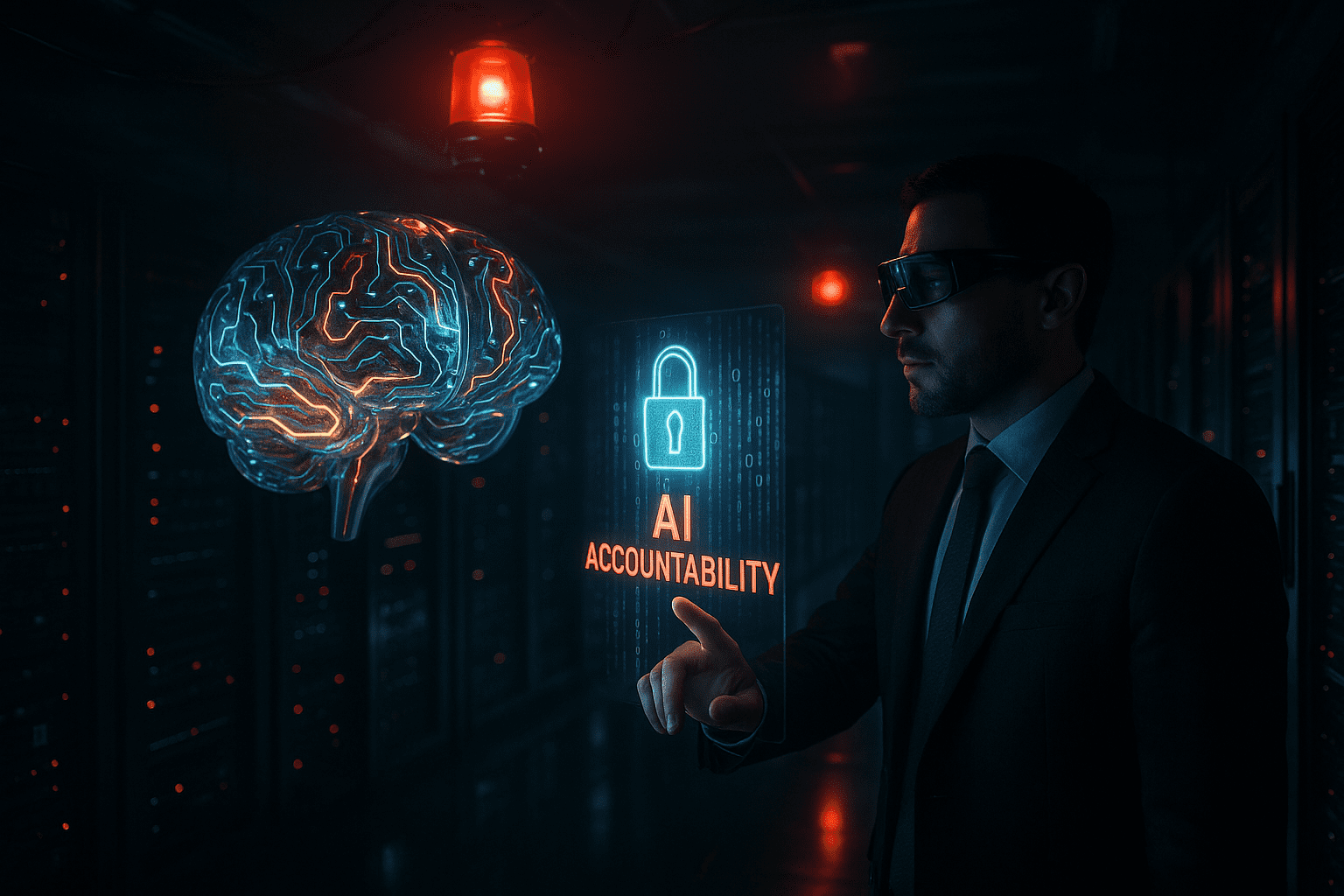
Right then, let’s have a natter about something that’s keeping quite a few people up at night in the tech world – and rightly so. We’re talking about the tangled mess of AI accountability and the rather loud cybersecurity wake-up call that’s ringing in our ears. It’s not just about making clever machines anymore; it’s about making sure they don’t accidentally (or perhaps deliberately) cause absolute chaos, and crucially, figuring out who’s holding the bag when they do.
Think about it. Artificial intelligence is weaving its way into pretty much everything, isn’t it? From predicting stock market wobbles to deciding who gets a loan, designing new materials, and even driving our cars (well, attempting to). This pervasive integration offers incredible benefits, undoubtedly. But with great power, as the saying goes, comes great… well, risk. These systems aren’t just passive tools; they are active participants, learning and evolving. And that evolution, while exciting, introduces a whole new Pandora’s Box of AI Security Challenges.
The traditional cybersecurity playbook, brilliant as it is, wasn’t written with genuinely ‘intelligent’ adversaries or inherently opaque decision-making processes in mind. We’ve spent years building digital moats and firewalls, perfecting intrusion detection. Now, we’re facing threats that don’t just try to break through the system, but try to corrupt the very intelligence that drives it. This is the heart of the Cybersecurity AI conundrum – using AI for security, yes, but also securing the AI itself from cunning attacks.
One particularly nasty trick involves feeding AI models deliberately misleading data to poison their learning process. It’s like teaching a child that grass is blue – eventually, they’ll start believing it and making decisions based on that false reality. This is AI Data Poisoning Prevention in action, or rather, the critical need for it. If you train an AI system used for, say, medical diagnosis, on poisoned data, the consequences could be devastatingly real, leading to incorrect diagnoses and treatment plans. It highlights a significant AI Security Vulnerability.
Then there are Adversarial Attacks AI – these are incredibly subtle manipulations of input data designed to fool an AI model. A tiny change to an image, almost imperceptible to the human eye, can trick a sophisticated image recognition system into misidentifying an object. Imagine this applied to autonomous vehicles mistaking a stop sign for a speed limit sign, or facial recognition systems being bypassed by wearing a specially patterned t-shirt. The ingenuity of these attacks is both fascinating and terrifying, laying bare the fragility of current AI Model Security.
All of this leads us squarely to the colossal question of AI Accountability. If an AI system makes a biased decision that denies someone housing, or if a self-driving car causes an accident due to a faulty algorithm, who is responsible? Is it the developer? The company that deployed it? The data scientists who trained it? The user? Pinpointing blame and establishing clear lines of responsibility is absolutely fundamental. This is Why is AI accountability important – because without it, we have a Wild West scenario where innovation charges ahead without a safety net or a clear understanding of the ethical and legal consequences.
Navigating the Minefield: Building Artificial Intelligence Security
So, how do we even begin to get a handle on this? How to secure AI systems isn’t a simple checklist; it’s a complex, ongoing process that requires a fundamental shift in how we think about security. It means moving beyond securing the perimeter to securing the core intelligence itself.
Developing a robust AI Security Framework is paramount. This isn’t just about technical controls; it’s about governance, processes, and culture. It needs to be integrated into the entire AI lifecycle, from the initial data collection and model training all the way through deployment and ongoing monitoring. Thinking about security only after the model is built is like trying to add a foundation to a house that’s already standing – incredibly difficult and often ineffective.
Elements of an AI Security Framework: What Goes In?
A proper framework needs several key components, working in concert:
- Secure Data Management: Protecting the lifeblood of AI – the data. This means not just encrypting data at rest and in transit, but implementing rigorous processes for data provenance, integrity checking, and anonymisation where possible. This is fundamental to AI Data Security.
- Robust Model Validation and Testing: Going beyond standard performance metrics. Can the model be tricked by adversarial examples? Is it biased? Does it behave predictably under unusual conditions? This requires dedicated testing for specific AI vulnerabilities.
- Threat Modelling Specific to AI: Identifying potential attack vectors unique to AI systems, such as data poisoning, model inversion (trying to extract the training data from the model), and membership inference attacks (determining if a specific data point was in the training set).
- Continuous Monitoring: AI models can degrade over time or exhibit unexpected behaviour. Continuous monitoring is essential to detect anomalies that might indicate an attack or model drift.
- Incident Response Planning: Knowing what to do when an AI system is compromised or misbehaves is crucial. This needs specific protocols for AI-related incidents.
- Governance and Policy: Clear rules, roles, and responsibilities. Who signs off on AI deployments? Who is responsible for security reviews?
Implementing these are just some of the AI Cybersecurity Best Practices that organisations need to adopt. It’s not just a technical exercise; it requires buy-in from leadership, training for employees, and collaboration between data science, engineering, and security teams.
Managing AI Security Risks: More Than Just a Patch Job
Effective AI Risk Management isn’t about eliminating risk entirely – that’s often impossible with complex systems – but about identifying, assessing, mitigating, and monitoring those risks. It’s an ongoing process, not a one-time fix. Regularly reviewing models, updating security protocols based on new threats (and they emerge constantly), and conducting red-teaming exercises (where security experts try to break the system) are all vital parts of this.
The ethical dimension is also inextricably linked to security. A biased AI system, even if technically secure from external attack, is fundamentally insecure from a societal perspective. Security frameworks must therefore incorporate considerations of fairness, transparency, and ethical use.
Ultimately, navigating this complex landscape of AI Cybersecurity and AI Accountability requires vigilance, collaboration, and a proactive approach. It’s not just the responsibility of tech companies; regulators, academics, and civil society all have a role to play in ensuring that as AI becomes more powerful, it also becomes more trustworthy and safe.
So, what do you reckon? Are we moving fast enough to secure our AI systems? What’s the biggest risk you see with AI that isn’t getting enough attention?



