

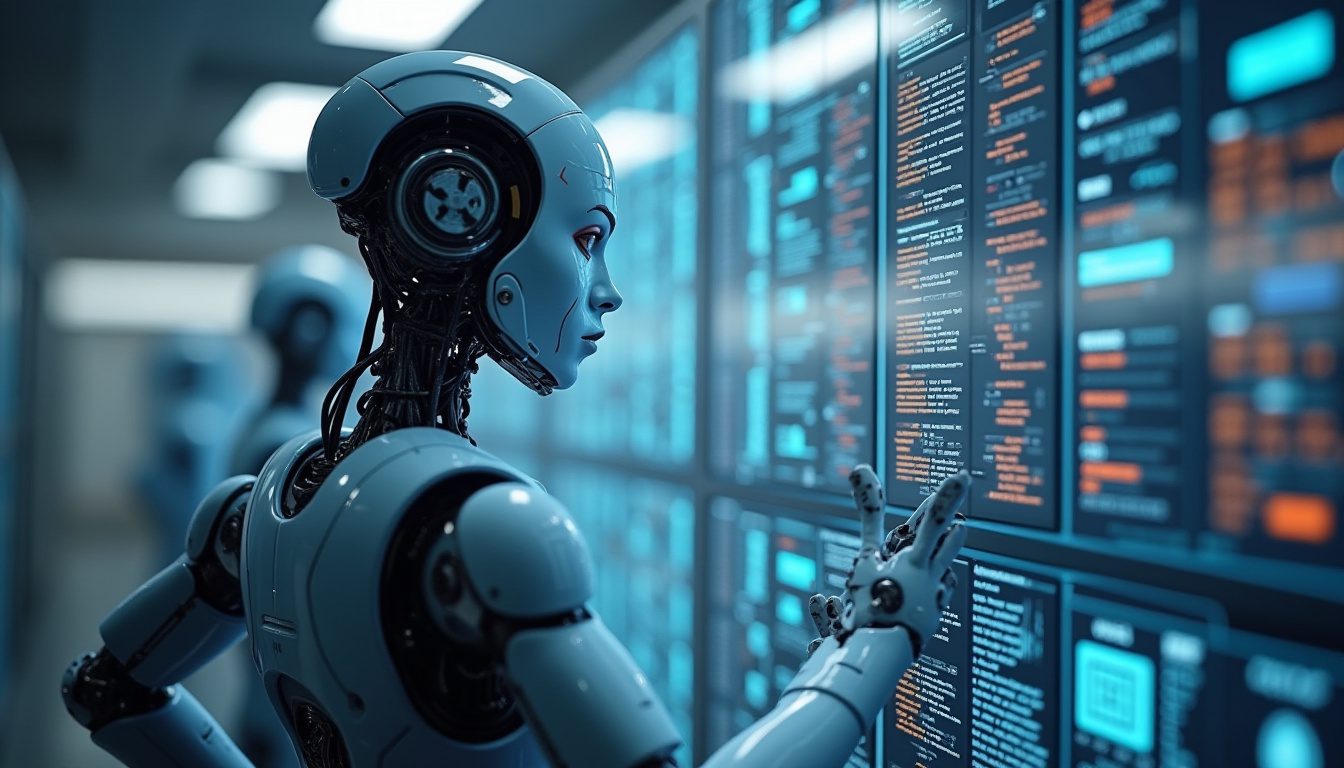
It sounds like the robots are coming to a factory floor near you, and perhaps sooner than many expected. Word is that the titans of tech hardware and manufacturing – that’s **Nvidia** and **Foxconn** – are having a serious chinwag about deploying humanoid robots in a rather crucial spot: their planned facility near Houston, Texas. This isn’t just any old factory; it’s earmarked for churning out those incredibly complex and highly sought-after AI servers. And the timeline they’re reportedly looking at? A brisk **early 2026**.
Now, let’s pause for a moment. **Nvidia**, the chip kingpin whose GPUs are the literal engines of the current AI gold rush, talking with **Foxconn**, the manufacturing behemoth that essentially builds everything from iPhones to server racks for the world. This isn’t just a casual chat over tea. This is two Goliaths looking at the absolute cutting edge of factory automation – **humanoid robots** – and potentially slotting them into the heart of AI infrastructure production. What does that tell you about where manufacturing, automation, and indeed, the entire AI boom is headed? It’s certainly not standing still.
Why Humanoid Robots in an AI Server Plant?
Why, you might ask, are they even contemplating something as seemingly futuristic as humanoid robots for building what are essentially really powerful computers? Well, building AI servers isn’t like assembling your flat-pack furniture. These are intricate machines, packed with expensive components, requiring precise handling and complex assembly steps. Traditional industrial robots are fantastic at repetitive, fixed tasks – welding car parts, moving boxes on a conveyor. But they’re often less flexible when tasks change or require navigating a more human-centric workspace.
This is where the allure of **humanoid robots in production** comes in. Think about it: robots with arms, hands (well, grippers that mimic hands), and the ability to move on legs (or wheels that approximate legs) can potentially operate in environments designed for humans. They could theoretically pick up tools, plug in cables, screw in bolts, and perform inspections – tasks that require dexterity and adaptability. If they can learn to do these things reliably, they could offer a level of automation that traditional robotic arms bolted to the floor simply cannot.
Furthermore, the demand for **AI servers** is simply astronomical right now. Companies are scrambling to get their hands on Nvidia’s H100s and the newer Blackwell chips to train and run large language models and other AI applications. Foxconn, as a key partner in building these powerhouses, needs to ramp up production significantly and efficiently. Adding advanced automation like humanoid robots could be a way to increase throughput, maintain quality control in complex assembly, and potentially operate around the clock without breaks.
The Strategic Significance of Houston
The choice of location – a planned plant near **Houston, Texas** – is also telling. There’s a broader push, both politically and economically, to bring more advanced manufacturing back to the United States. Building a cutting-edge **Houston manufacturing plant** for AI servers isn’t just about logistics; it’s about creating a domestic supply chain for critical technology infrastructure.
Setting up a plant like this, especially one incorporating potentially revolutionary automation like humanoid robots, in the US comes with its own set of challenges, not least of which is labor cost compared to traditional manufacturing hubs. If humanoid robots can genuinely perform complex assembly tasks efficiently and reliably, they could significantly alter the economics of manufacturing in higher-wage regions. It’s a bold move that could reshape how we think about **US technology manufacturing**.
Nvidia and Foxconn: A Partnership Deepening
This isn’t the first dance between Nvidia and Foxconn. They’ve been collaborating on various projects, including AI server infrastructure. This potential move into deploying humanoid robots together suggests a deepening of their partnership, focusing now on the very methods of production itself.
Nvidia, under Jensen Huang, isn’t just a chip company anymore; it’s positioning itself as a full-stack AI company, involved in everything from the silicon to the software (like its Omniverse platform for digital twins) and now, seemingly, the physical robots that might build the future. Foxconn, led by Young Liu, has long been a leader in mass production, but is also actively exploring advanced manufacturing technologies and automation to stay ahead in a competitive global market.
Their joint exploration of **AI automation factory** concepts, particularly involving sophisticated robotics, highlights a shared vision of manufacturing’s future. It’s a future where the lines between digital design (digital twins of factories, perhaps?) and physical execution are blurred, driven by AI and powered by increasingly capable robots.
The Humanoid Robot Landscape
So, who are these potential robot workers? While the article might not name specific companies, the field of humanoid robotics is seeing a surge in activity. Companies like Figure AI (which has investment from tech giants including Microsoft and, yes, Nvidia), Unitree Robotics, Boston Dynamics, and Tesla with its Optimus robot, are all developing human-like robots for potential use in logistics, manufacturing, and other labor-intensive tasks.
These robots are rapidly evolving. They are getting better at manipulation, navigation, and learning new tasks, often powered by advanced AI systems (which, iron-man style, are often running on Nvidia GPUs). The idea is that a general-purpose humanoid robot could be programmed to do a wide variety of tasks in a factory setting, offering flexibility that single-purpose machines lack. Imagine a robot being taught to assemble one type of server module today and a different one tomorrow, simply through software updates and AI training. That’s the promise, at least.
Potential Hurdles and Realities
Before we all start picturing robot armies building our computers, it’s crucial to remember this is still early days. Deploying humanoid robots at scale in a sophisticated manufacturing environment like an AI server plant comes with significant hurdles.
Firstly, the technology, while rapidly advancing, is still maturing. Can these robots reliably perform intricate assembly tasks hour after hour without errors? What about dealing with unexpected situations on the factory floor?
Secondly, the cost. While still rapidly advancing, many humanoid robots remain expensive prototypes or early-stage products, although some models are beginning to reach early commercial availability and deployment. Integrating them into a large-scale manufacturing line will require substantial investment not just in the robots themselves, but in the infrastructure, software, and training needed to manage them.
Thirdly, the integration challenge. A factory floor is a complex ecosystem of machines, humans, and processes. Seamlessly integrating a new class of highly sophisticated, AI-powered robots into this environment requires significant engineering and planning. This isn’t just plugging in a new machine; it’s potentially rethinking workflows and factory layouts.
And let’s not forget the human element. The potential use of robots, especially humanoids, inevitably raises questions about labor. Will these robots replace human workers? Or will they work alongside them, handling the dull, dirty, or dangerous tasks while humans focus on higher-level supervision, maintenance, and problem-solving? This is a critical conversation that needs to be part of the development and deployment process for **factory automation** this advanced. The goal, arguably, should be augmentation, not just displacement, creating safer and more productive jobs.
Looking Ahead: The Future of Manufacturing?
If this collaboration between Nvidia and Foxconn proves successful, it could set a precedent for the future of manufacturing, particularly in advanced technology sectors. It’s a fascinating glimpse into how AI isn’t just changing *what* we build (more powerful AI systems), but *how* we build it.
This isn’t just about putting robots on a factory floor; it’s about creating more intelligent, flexible, and automated production systems. It ties into concepts like the **digital twin factory**, where a virtual replica of the plant is used to simulate, test, and optimise processes before they are implemented in the real world. Nvidia’s Omniverse platform is precisely designed for this kind of simulation and collaboration, hinting at how they might provide the underlying technology for these automated factories of the future.
The potential impact is huge. Faster production, higher quality, potentially lower costs in the long run, and the ability to manufacture complex goods in more diverse geographical locations. This move by Nvidia and Foxconn could be a significant step towards realising that vision.
What do you think about humanoid robots entering the manufacturing world? Do you see them as the key to future factory efficiency, or are there significant challenges still to overcome? How might this change the landscape for jobs in manufacturing?



