

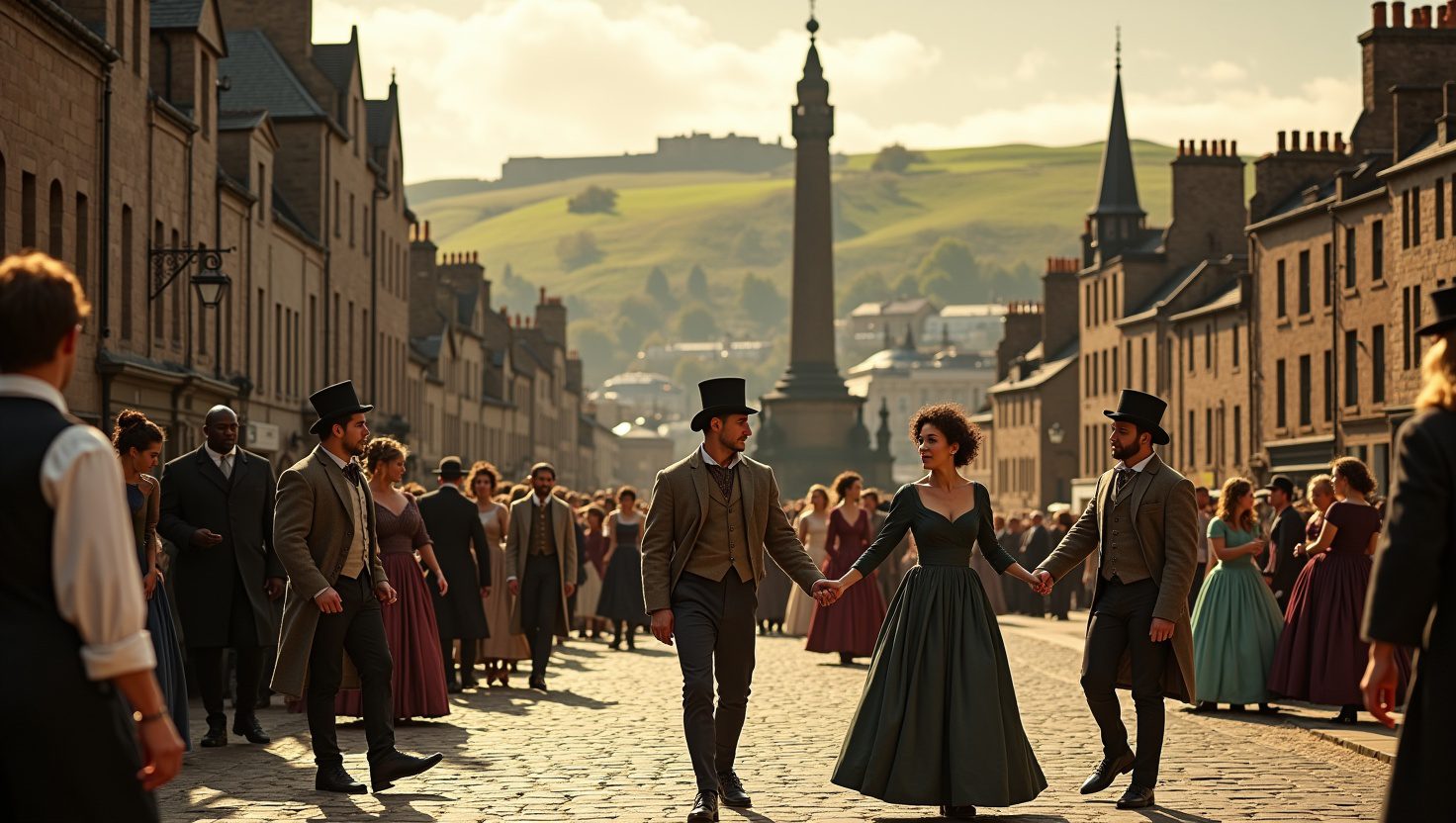
If you think the current AI boom is just about snarky chatbots or generating faintly terrifying images of people with too many teeth, you’re missing a far more profound story unfolding. We’re seeing technology being used not just to predict the future, but to vividly resurrect the past. And there’s no better example of this right now than the stunning AI historical city recreation of 18th-century Edinburgh. It’s a glimpse into how we’ll experience history from now on—not just by reading about it, but by walking through it.
So, How Is AI Becoming Our Digital Archaeologist?
For years, historians and archaeologists have relied on sketches, maps, and dusty records to piece together what life was like. It’s painstaking, brilliant work, but it often leaves the final picture in the imagination of the reader. What AI brings to the table is the power of synthesis and motion. It’s not just a digital paintbrush; it’s more like a digital master weaver.
Think of it this way: a historian might have ten different sketches of a single street, each from a slightly different angle, drawn by different artists with their own quirks. Piecing that together in your mind is tricky. An AI, however, can analyse all those sources simultaneously, identify the common architectural features, fill in the gaps based on known styles of the era, and then render a complete, three-dimensional space. This isn’t about replacing the historian; it’s about giving them a super-powered toolkit for urban history visualization. It’s the difference between looking at a blueprint and taking a virtual tour of the finished house.
A Digital Ghost: Walking Through 18th-Century Edinburgh
This brings us to the work of the YouTube channel ‘Matt Reconstructs History’, which was recently highlighted in a fascinating piece by the Daily Record. The creator, Matt, has been feeding period sketches of Scotland’s capital into an AI system. The result? A breathtaking Edinburgh 1700s reconstruction that brings the city to life in colourised motion.
We see a version of Edinburgh Castle that is both familiar and alien, perched above sprawling fields and the long-vanished Nor’ Loch. Holyrood Palace stands not as a modern tourist attraction, but as a functioning royal residence in a landscape that feels almost rural. It’s a powerful reminder that cities are living, breathing things that change dramatically over time. These aren’t just static images; the videos give a sense of what it might have felt like to approach the city on a horse-drawn carriage, seeing these iconic landmarks emerge from the mist.
This digital archaeology allows us to contextualise the past in a way static images never could. It answers questions that are hard to grasp from a map alone. How imposing did the castle really feel from the Grassmarket? What was the relationship between the Old Town, crowded and chaotic, and the open spaces that surrounded it? This is where the true value emerges.
The Limits of the Lens: AI and the Bias Problem
Now, before we get completely carried away, it’s crucial to address the elephant in the digital room: bias. As the creator himself wisely notes, “‘AI is trained on datasets and will always contain a degree of bias'”. This is a point that simply cannot be overstated.
Imagine you wanted to build an AI to understand what a “classic British meal” is. If you only feed it pictures and recipes from London’s most expensive restaurants, it will conclude that everyone in Britain eats tasting menus featuring foie gras and truffle foam. It would have no concept of a chip butty, a Sunday roast, or a jacket potato. Your AI’s understanding would be skewed by its privileged, narrow dataset.
The same principle applies here. The period sketches used for the Edinburgh 1700s reconstruction were likely created by wealthy visitors or educated artists. Their focus would have been on grand castles and picturesque landscapes, not the squalor of the city’s infamous tenements or the daily lives of the poor. The AI, therefore, reconstructs a version of Edinburgh that reflects its “training data”—a sort of “greatest hits” tour rather than the full, messy reality. Acknowledging this isn’t a criticism of the project; it’s a vital part of using this technology responsibly.
What’s Next on the Digital Frontier?
The potential for AI archaeology applications extends far beyond building pretty cityscapes. Imagine AIs that can piece together fragmented pottery in minutes, a task that could take a human expert months. Or systems that can analyse soil patterns from drone footage to predict the location of undiscovered Roman villas or Viking settlements. We are at the very beginning of this field.
The creator of the Edinburgh project isn’t stopping there. According to the Daily Record, he has plans to tackle other historical periods, including the American Wild West and the 1849 Gold Rush. Think about that for a moment. What would a bustling, muddy, and chaotic San Francisco look like in motion, reconstructed from the few daguerreotypes and sketches that survive? The potential for education and entertainment is enormous.
This technology allows us to become digital time travellers. It transforms history from a passive subject into an active experience. Soon, a history lesson for a child might not involve just reading a textbook, but taking a VR walk through the reconstructed streets of the city they’re studying. That’s a powerful shift.
Rewriting History, One Pixel at a Time
So, is this the future of how we connect with our past? Almost certainly. The ability of AI to synthesise vast amounts of visual data into a coherent world is a game-changer for historians, filmmakers, game developers, and anyone curious about the world that was.
These tools are becoming more accessible every day, which means we’ll see an explosion of similar projects. The key will be to approach them with both wonder and a healthy dose of critical thinking. We must always ask: whose story is this reconstruction telling, and, just as importantly, whose is it leaving out? The technology is a mirror, and it will reflect the biases of the data we show it.
As we get better at resurrecting these digital ghosts, the question isn’t just what we can rebuild, but whose story we choose to tell.
What lost city or moment in time would you want to see brought back to life using this technology? Share your thoughts below.



