

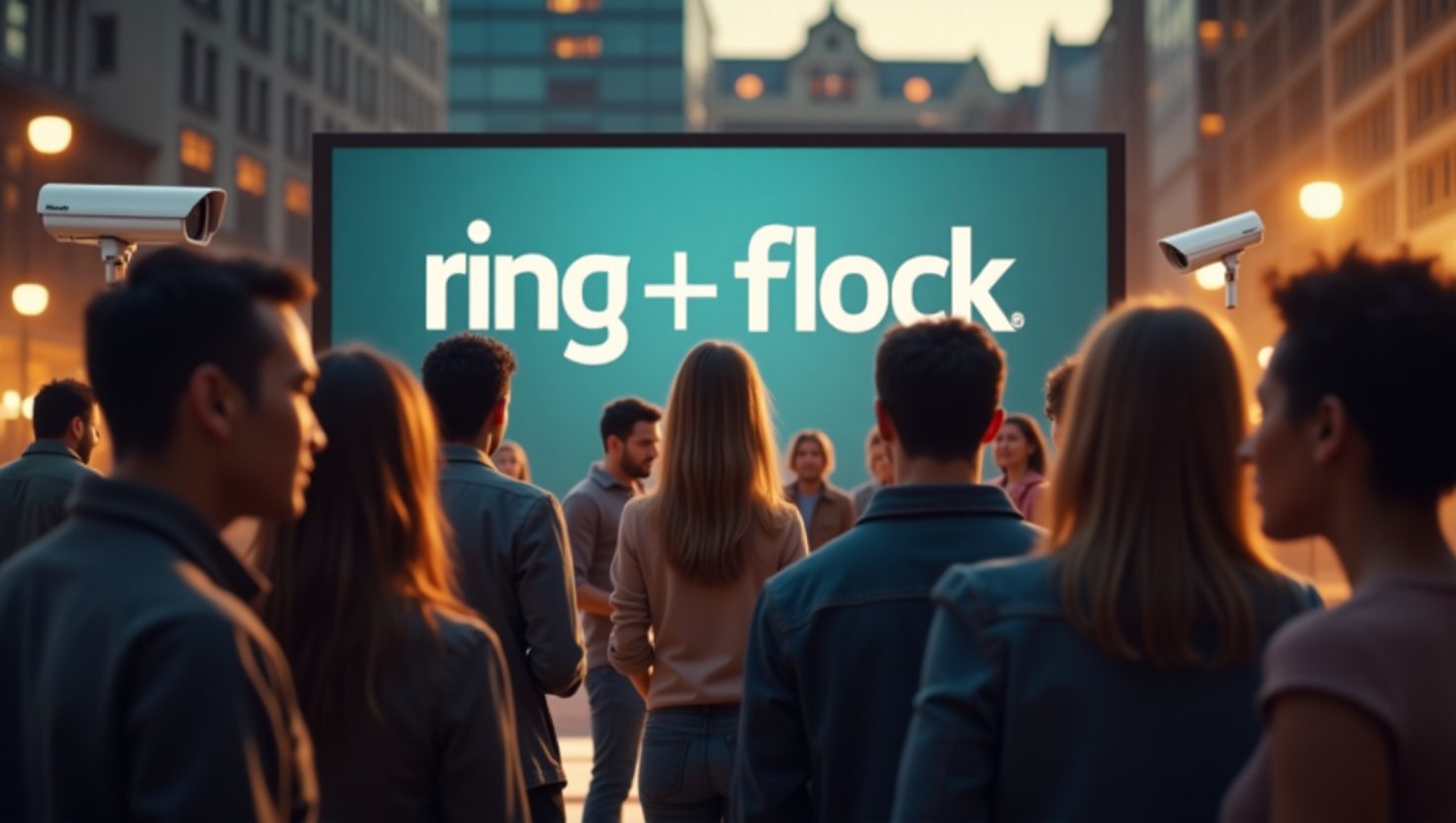
So, Ring, the Amazon-owned doorbell company, just did a very public U-turn. They’ve slammed the brakes on a planned partnership with Flock Safety, a firm that specialises in networking private security cameras into a giant, automated surveillance web. Why? Because of a little thing called the Super Bowl. An ad from a rival, SimpliSafe, took a pop at Ring’s surveillance culture, and the resulting public conversation got so hot that Ring had to back away. This isn’t just a simple corporate hiccup; it’s the latest and loudest signal of a growing AI surveillance backlash that the tech industry can no longer ignore.
This isn’t just about doorbells. It’s about the uneasy feeling that our world is quietly being blanketed in a layer of software that watches, analyses, and judges. From our front porches to our public squares, the rise of connected cameras and the AI that powers them is forcing a long-overdue conversation about privacy, ethics, and control. And as we’re seeing, consumer tech activism is finally finding its voice.
The All-Seeing Eye, Now with an API
What on Earth is AI Surveillance?
Let’s be clear. This isn’t your grandad’s grainy CCTV footage. AI surveillance is what happens when you connect cameras to a brain. This brain, a complex set of algorithms, doesn’t just record; it interprets. It can perform facial recognition, track number plates across a city, flag “unusual” behaviour, and build a detailed pattern of your life without a single human watching in real time.
Think of it like this: a normal security camera is a passive guard taking notes. An AI-powered camera is an intensely proactive guard that has memorised every face it’s ever seen and can instantly cross-reference them with a million other photos. Flock Safety’s entire business model is built on this principle, creating private surveillance networks for neighbourhoods and police forces. The plan was to plug Ring’s army of doorbells into this network, and that’s precisely where the public drew the line.
Your Friendly Neighbourhood Watch is Now a Data-Mining Operation
The growth in public surveillance is staggering, and it’s not just coming from the government. Companies like Ring and Flock have adopted a brilliant, if slightly sinister, strategy. They sell security and convenience to individuals, but the real value is created when all those individual cameras are networked together. Each new camera sold doesn’t just protect one home; it adds another node to a sprawling, privately-owned surveillance grid.
This strategy hinges on network effects. The more cameras in the Flock system, the more powerful its tracking capabilities become, and the more attractive it is to law enforcement subscribers. It’s a flywheel that spins faster with every sale, quietly building a surveillance infrastructure that bypasses public debate. Until, that is, it gets a prime-time spotlight during the biggest sporting event of the year.
The Ethical Tightrope: Security vs. Anonymity
Do We Really Need Facial Recognition in Our Smart Glasses?
The core of the backlash revolves around facial recognition ethics. Are we comfortable with technology that can identify us anywhere, anytime, without our consent? Tech companies often pitch this as a tool for good—catching criminals or finding missing people. But the potential for misuse is colossal.
Just look at Clearview AI, a company that scraped billions of photos from social media to build a facial recognition database it then sold to law enforcement. Despite unending controversy, US Customs and Border Protection just signed a $225,000 deal with them, as reported by Wired. This is how it happens: mission creep. A technology created for one purpose quickly gets adopted for another, normalising mass surveillance one government contract at a time. It’s no wonder that Meta, in a leaked internal memo, was reportedly planning to push ahead with facial recognition in its smart glasses, seeing a window of opportunity while, in their own words, “many civil society groups that we would expect to attack us would have their resources focused on other concerns”. The sheer conceit is breathtaking.
The Problem Isn’t Just the Tech, It’s the Trust
Unsurprisingly, the public has deep-seated privacy concerns technology like this creates. This isn’t just a niche worry for activists anymore. People are becoming acutely aware of the trade-off. Is the convenience of a smart doorbell worth contributing to a system that could one day misidentify you, track your movements, or be used to monitor peaceful protests?
Ring’s decision to scrap the Flock deal shows they’ve recognised this shift. Their statement was a masterclass in corporate damage control: “‘The integration never launched, so no Ring customer videos were ever sent to Flock Safety'”. It completely misses the point. The backlash wasn’t about data that had already been shared; it was about the chilling potential of the partnership. It was one of the biggest AI marketing misfires in recent memory because it exposed the company’s ultimate ambition far too clearly.
The Law is Lagging, and the Consequences are Real
Who Decides the Limits?
Right now, we are operating in a legal grey area. The rules governing public surveillance limits are often outdated, outmanoeuvred, or simply non-existent. The technology is advancing at a blistering pace, while our legal and regulatory frameworks are stuck in the slow lane.
We’re already seeing public systems straining under the weight of data-driven enforcement. In Minnesota, for instance, court filings from Immigration and Customs Enforcement (ICE) “skyrocketed in January”, overwhelming the judicial system. This is a direct consequence of a technologically-enabled, high-volume approach to enforcement. When you can track and identify people at scale, you can generate cases at a scale the justice system was never designed to handle.
So what happens next? We are likely to see a wave of new regulations, probably starting at the city and state level, attempting to rein this in. But the bigger battle will be over federal laws and the fundamental question of whether private companies should be allowed to build and operate these mass surveillance networks at all.
From Doorbell Cams to Crypto Crime
The debate is complex. Proponents will point to very real problems that AI surveillance could help solve. For example, the blockchain analysis firm Chainalysis recently reported that transactions linked to human trafficking have “nearly doubled over the past year, with hundreds of millions of dollars in transactions annually”.
This is a horrific crime, and using technology to fight it seems like a noble goal. But it’s a slippery slope. Do we grant companies and governments unprecedented surveillance powers to chase crypto transactions, knowing those same powers can be turned on anyone? Iran’s use of internet shutdowns and digital surveillance to crush protests is a stark reminder of how these tools are used by authoritarian regimes. The line between security and oppression is perilously thin.
Ring’s botched Flock deal is more than just a PR blunder. It’s a landmark case. It proves that public pressure can work and that even tech giants are not immune to the court of public opinion. The AI surveillance backlash has forced a multi-billion-dollar company to rethink its strategy. It shows that people are no longer willing to silently trade their privacy for a bit of convenience.
The tech industry is at a crossroads. It can continue to push the boundaries, hoping no one notices until it’s too late, or it can start engaging in an honest conversation about the kind of society its products are creating. The era of building first and asking for forgiveness later may finally be coming to an end.
What do you think? Is this backlash a temporary setback for the surveillance industry, or has a permanent line been drawn in the sand? Let me know your thoughts below.



