

For years, the story of advanced artificial intelligence has been written almost exclusively in Silicon Valley. The main characters were familiar: Google, Meta, OpenAI. But it seems someone forgot to tell Beijing. The narrative is being rewritten, and the latest chapter, as reported by outlets like CNBC, shows China’s AI development isn’t just catching up; it’s starting to set the pace in crucial areas. This isn’t just about code; it’s geopolitics played out in algorithms.
Let’s be clear: this isn’t a sudden development. The groundwork has been laid for years. But the recent flurry of announcements from China’s tech titans feels like a coordinated declaration of intent. The global AI competition has a formidable new front, and anyone who isn’t paying attention is already behind.
The Titans Have Awakened
The names leading this charge are hardly unknown. Alibaba, the e-commerce and cloud behemoth; ByteDance, the quiet giant behind TikTok; and Kuaishou, its domestic social media rival. These companies aren’t just dabbling in AI; they are embedding it into the core of their strategy, leveraging immense datasets and national ambition to push the boundaries of Chinese tech innovation.
What we’re seeing is a pivot from imitation to genuine invention. For too long, the West has patronisingly viewed Chinese tech as simply adept at copying. This week’s announcements should put that lazy thinking to bed for good.
A Barrage of Advanced AI
The sheer variety of the models unveiled is telling. This isn’t a one-trick pony show. China is competing on multiple fronts simultaneously.
Alibaba’s Move into the Physical World
Perhaps the most intriguing release comes from Alibaba AI research. They’ve unveiled RynnBrain, an AI model designed not just for pixels on a screen but for interacting with the real world. Its purpose is to give robots a better understanding of physical objects.
Think of it this way: most AI today is like a brain in a jar. It can process information, but it can’t interact with what’s around it. RynnBrain aims to connect that brain to a body. Researcher Adina Yakefu, quoted in the CNBC report, highlighted that “one of its key innovations is built-in time and space awareness.” This is a fundamental step towards creating autonomous robots that can navigate and manipulate objects in complex, unstructured environments like a warehouse or, one day, a home. This is a direct challenge to the work being done at Nvidia and Google.
The Video Generation Race Heats Up
Meanwhile, ByteDance and Kuaishou are locked in a battle over generative video, a field that has captured the public’s imagination.
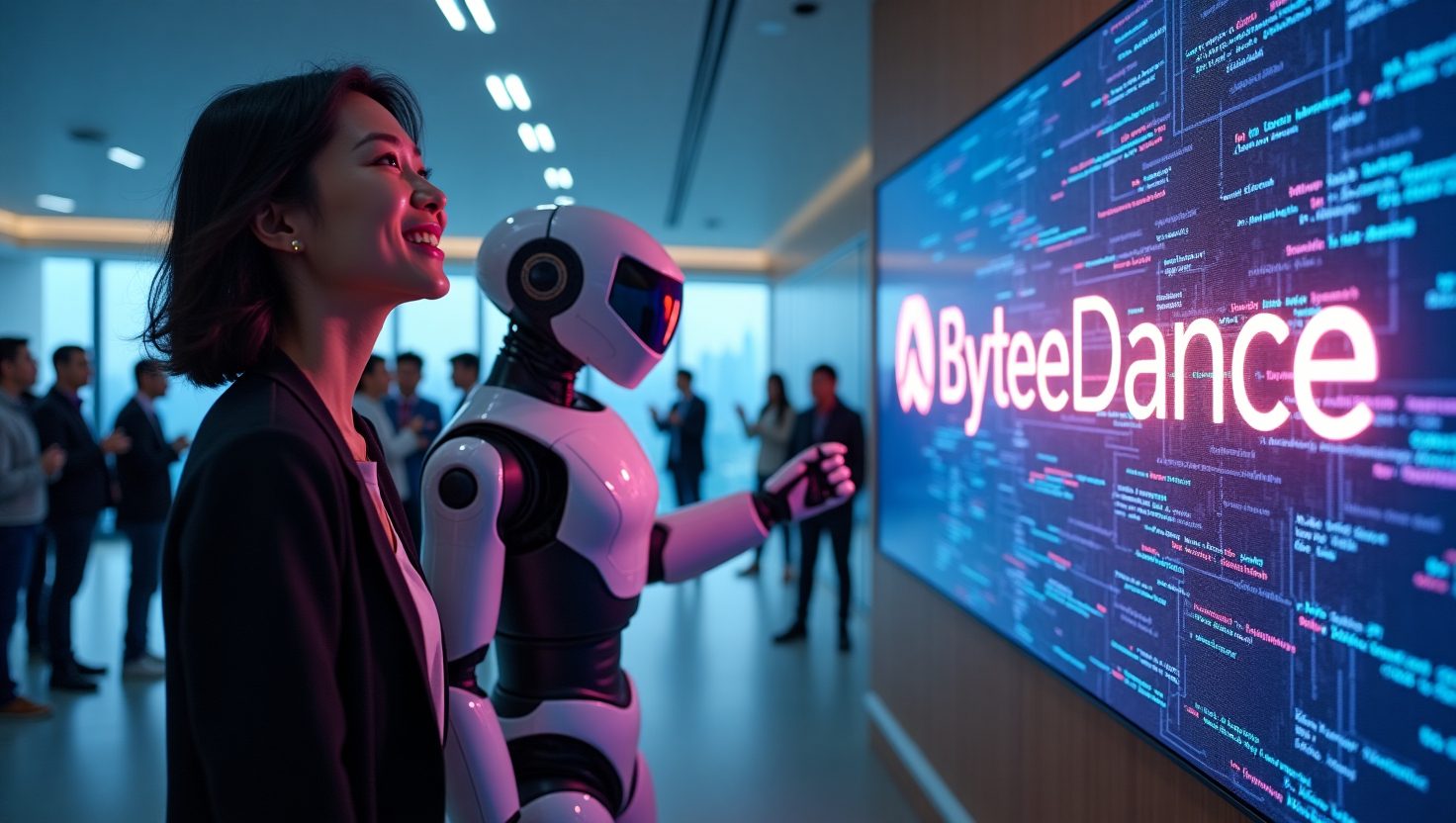
ByteDance, whose entire empire is built on short-form video, introduced Seedance 2.0. This isn’t surprising; mastering AI video is existential for them. The Seedance AI models aim to generate hyper-realistic video clips from simple text prompts. According to Yakefu, “Seedance 2.0 is one of the most well-rounded video generation models I’ve tested so far.” Coming from an independent researcher, that’s high praise.
Not to be outdone, Kuaishou launched its competitor, Kling 3.0. It boasts impressive features, including the ability to generate videos up to 15 seconds long—a significant duration in this space—and improved audio-visual synchronisation. The market has certainly noticed; Kuaishou’s shares have soared more than 50% over the last year, a clear signal of investor confidence.
The Open-Source Offensive
Beyond proprietary models locked inside corporate walls, China is also making serious moves in open-source AI. This is a clever strategic play, building a global community of developers who use and improve Chinese-built tools.
– Zhipu AI’s GLM-5: This open-source model is making audacious claims, stating that it approaches the performance of Anthropic’s Claude Opus 4.5 in coding benchmarks. More impressively, it reportedly surpasses Google’s Gemini 3 Pro on some tests. Providing powerful tools for free is a classic way to win hearts and minds in the developer world.
– MiniMax’s M2.5: This new model focuses on enhanced AI agent capabilities. An AI agent is like a digital personal assistant on steroids, capable of understanding complex goals and executing multi-step tasks autonomously. Improving these capabilities is key to moving AI from a simple chatbot to a genuine productivity tool.
A New Front in the Tech Cold War?
So, what does this all mean? We are witnessing a fundamental shift in the AI landscape. The global AI competition is no longer a one-horse race. For years, US companies held an undisputed lead. Now, Chinese models are achieving parity, or even superiority, in specific domains like video generation and are closing the gap rapidly in others.
This is less like a traditional sports competition and more like the space race of the 20th century. Two geopolitical rivals are pouring immense resources into technological advancement, not just for commercial gain but for national pride and strategic advantage. The difference is that the fruits of this a-race—the AI models themselves—can be deployed globally in an instant, shifting the dynamics of information, creativity, and commerce.
The Dawn of Asia-Pacific Tech Leadership
These breakthroughs are cementing a new reality: the future of technology is being forged not just in California, but across the Pacific. This rapid China AI development is the engine driving a broader assertion of Asia-Pacific tech leadership. As these models improve and proliferate, they will empower a new generation of start-ups and innovators across the region, creating an ecosystem that is less dependent on Western technology.
The long-term implications are profound. Will we see a bifurcation of the internet, with one sphere dominated by US-centric AI and another by Chinese-led AI? How will global standards for AI safety and ethics be shaped when the leading developers have fundamentally different political systems?
This isn’t just about whether a Chinese model can generate a better cat video than an American one. It’s about who writes the rules for the next era of technology. The frantic pace of Chinese tech innovation suggests that the rulebook is still very much up for grabs. Staying informed isn’t just for tech enthusiasts anymore; it’s a civic necessity.
What do you think? Is this fierce competition ultimately good for innovation, or does the geopolitical rivalry pose a greater risk?



