

Let’s be clear: a voice is more than just sound waves vibrating through the air. It’s identity. It’s emotion. It’s how we tell stories, sing lullabies, and argue about who was meant to take the bins out. So what happens when that’s taken away? For years, the answer was a grim silence, often replaced by a robotic, impersonal text-to-speech device. But that’s changing, and not because of some small, incremental improvement. It’s changing because of a profound leap in AI voice restoration.
This isn’t just another tech-for-good story that feels nice but lacks substance. We’re talking about a technology that is fundamentally restoring a piece of someone’s soul. For individuals with degenerative diseases like Amyotrophic Lateral Sclerosis (ALS), where the body slowly betrays the mind, losing the ability to speak is one of the cruelest blows. This is where artificial intelligence stops being an abstract concept and becomes a deeply human lifeline.
Understanding the Digital Phoenix: How AI Voice Restoration Works
So, what exactly is AI voice restoration? Forget those clunky, monotone voices of the past. Think of this technology as a digital artisan, a specialist in vocal reconstruction. At its core, it uses sophisticated machine learning models to analyse existing recordings of a person’s voice—even snippets from old home videos or phone calls. It learns the unique pitch, cadence, tone, and rhythm, essentially creating a digital blueprint of that voice.
The process is a bit like a forensic artist sketching a face from descriptions and old photographs, but for sound. The AI needs source material—the clearer, the better. It then uses this data to generate new speech or, in some extraordinary cases, even song, in that same voice. This isn’t just playback. It’s synthesis. It’s the creation of something entirely new from the essence of what was lost, with powerful implications for medical AI applications.
Patrick’s Song: A Story of Hope and Code
The Unsilenceable Musician
To understand the power of this, you need to know about Patrick Darling. As reported by MIT Technology Review, Patrick was a musician diagnosed with ALS at just 29. The disease relentlessly took away his ability to play instruments and, eventually, his ability to speak and sing. “Sadly, I have lost the ability to sing and play my instruments,” he communicated, the words a stark summary of an artist’s nightmare. For him, losing his voice wasn’t just losing communication; it was losing his art.
Imagine your primary tool for creation, for joy, for connection, being locked away inside you. That was his reality. Communicating through eye-tracking software is a marvel, yes, but it doesn’t let you belt out a chorus or harmonise with your bandmates.
A Lifeline from ElevenLabs
Enter ElevenLabs technology. The company, known for its advanced voice AI, has an impact programme providing free access to those who have lost their voices. Patrick’s case was a challenge. The ideal process requires about ten minutes of clean audio. Patrick’s team, including UCL researcher Richard Cave, had to work with what they could find: low-quality recordings from pubs and kitchens. It was the sonic equivalent of trying to restore a masterpiece from a few faded, coffee-stained photos.
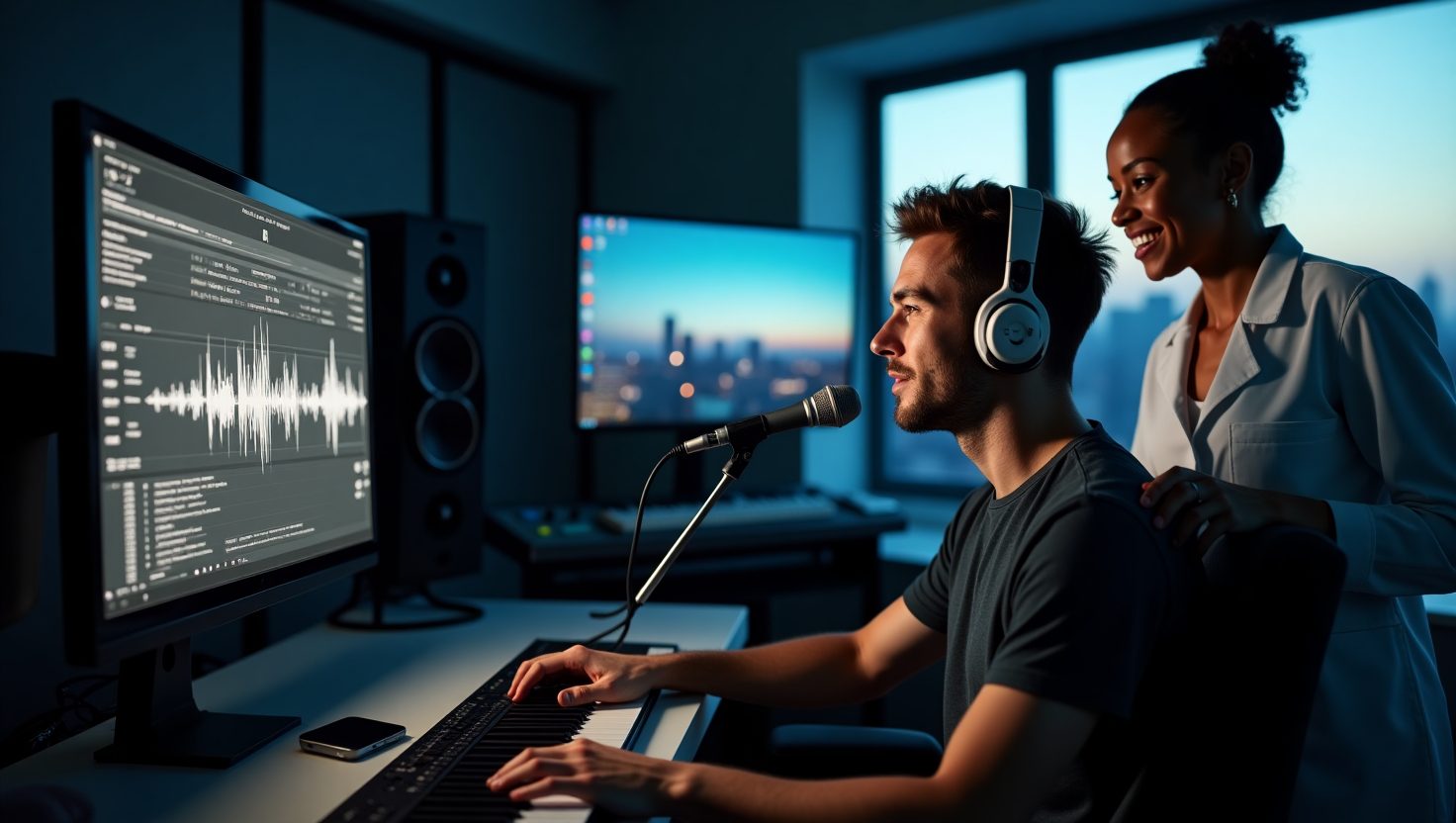
Yet, they did it. They pieced together enough of Patrick’s vocal identity to create a high-fidelity synthetic clone. The result was stunning. In Patrick’s own words, “It sounded exactly like I had before, and you literally wouldn’t be able to tell the difference.” This wasn’t just about speaking again. Using ElevenLabs’ AI music generator, Patrick composed a new song. After six weeks of meticulous fine-tuning—a collaboration between human creativity and AI precision—he performed it with his old bandmates. It was his first time back on stage in two years, a moment of pure, unadulterated triumph.
More Than a Voice: The Broader Impact
A New Frontier for Medical AI
Patrick Darling’s story is a powerful headline, but the implications are far wider. This is a landmark moment for medical AI applications and specifically for ALS voice synthesis. The technology offers a future where a diagnosis that silences the voice no longer silences the person. Think of patients recovering from throat cancer, stroke survivors with aphasia, or anyone with a condition that affects speech.
We are moving from assistive technology that simply replaces a function to restorative technology that recreates it with personal identity intact. This shift is monumental. It’s the difference between being given a generic wheelchair and a custom-built prosthetic that lets you run again. It restores not just capability, but a sense of self.
Unlocking Creative Potential
The creative aspect cannot be overstated. The technology didn’t just give Patrick a voice; it gave him back his microphone. It shows that physical limitations don’t have to be a barrier to artistic expression. An artist trapped in a body that won’t cooperate can still create, compose, and perform. This opens up entirely new avenues for collaboration and creation, where AI acts as a bridge between a creator’s mind and the final product.
The Necessary Conversation: Ethics and Authenticity
Of course, with great power comes a dizzying set of ethical questions. It’s impossible—and irresponsible—to talk about this technology without acknowledging the potential for misuse. If we can perfectly clone a voice, what stops someone from creating deepfake audio to impersonate a politician, a CEO, or a family member? Who legally owns a voice clone? Is it the person, their estate, or the company that created the AI?
These aren’t hypothetical problems for some distant future; they are here, now. Companies like ElevenLabs are building in safeguards, but the conversation needs to be much bigger. We need to establish clear frameworks around consent, ownership, and authenticity. Trust is the currency of communication, and as we blend human and synthetic voices, we must be careful not to devalue it. The solution isn’t to stop innovation, but to build the ethical guardrails as we go.
The Future is Biotech Innovation
Looking ahead, this is just the beginning of biotech innovation in the vocal sphere. What’s next? Imagine real-time voice cloning that can capture the emotional nuance of a conversation as it happens. Picture this technology integrated with brain-computer interfaces (BCIs), allowing someone who is completely paralysed to speak their thoughts in their own voice, in real time.
The research and development in this field is accelerating. As the AI models become more efficient and the hardware more accessible, tools that seem extraordinary today could become standard therapeutic options tomorrow. The journey, as detailed in the MIT Technology Review report, shows a clear trajectory towards more personalised and powerful solutions.
This journey from silence to song, powered by code and data, is a powerful testament to human resilience and ingenuity. AI voice restoration is giving people back a fundamental part of who they are, proving that technology’s greatest purpose isn’t just to make our lives more convenient, but to make them more human. It allowed a musician to sing again, and in doing so, it gave us all a glimpse of a future where fewer things are truly impossible.
What other human limitations do you think AI could help us overcome in the near future? Share your thoughts below.



