

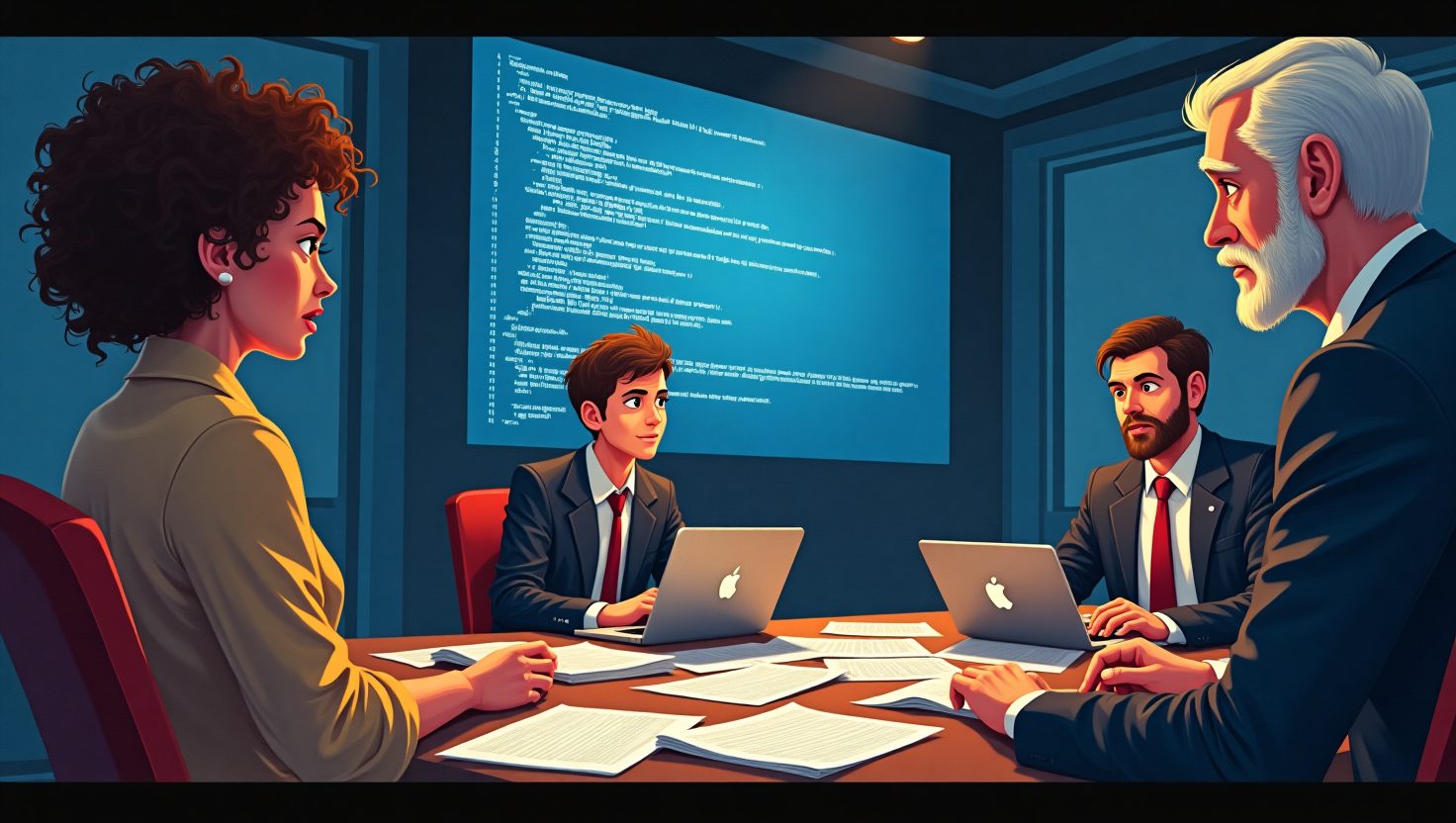
So, another week, another AI marvel threatening to upend an entire industry. It seems we’ve moved on from text and images and are now firmly in the era of ultra-realistic video generation. While tools like OpenAI’s Sora dazzled us with their creative potential, a new player has entered the arena and immediately tripped over the tripwire of intellectual property. The battleground is set, and the central conflict is all about AI video copyright, a messy, high-stakes collision of technology, law, and Hollywood’s very soul.
The Seedance Controversy: A Copyright Catastrophe in the Making?
Let’s be clear about what’s happening. ByteDance, the company behind TikTok, has been quietly developing a new text-to-video AI model called Seedance 2.0. Leaked footage revealed its unnerving capability: creating photorealistic video clips based on simple prompts. The problem? Those clips featured uncannily accurate, and entirely unauthorised, likenesses of A-list actors like Tom Cruise and Brad Pitt, often recreating scenes from their famous films.
Imagine a digital photocopier that doesn’t just copy a page from a book, but can take that page, rejig the sentences, and spit out a new paragraph that feels original but is fundamentally built from someone else’s work. That’s Seedance in a nutshell. This wasn’t some niche experiment; it was a shot across the bow of the entire entertainment industry.
Hollywood Hits Back, Hard
The reaction was as swift as it was furious. The Motion Picture Association (MPA), which represents the titans of entertainment—think Netflix, Disney, Warner Bros., and Paramount—didn’t mince its words. In a statement dripping with indignation, MPA chief Charles Rivkin accused ByteDance of “disregarding well-established copyright law” and demanded they “immediately cease its infringing activity.”
You can practically feel the panic emanating from the Hollywood Hills. Rhett Reese, the writer behind the Deadpool blockbusters, captured the mood perfectly with his bleak assessment: “I hate to say it. It’s likely over for us.” He spoke of a deep-seated terror among his peers, who see their careers, built over decades of hard graft, being threatened by an algorithm that can replicate their output in seconds. This isn’t just about actors’ likenesses; it’s about the potential for synthetic media to devalue the entire creative process.
The Minefield of Deepfake Regulation
This whole Seedance controversy throws a harsh spotlight on a gnarly problem: how do you regulate something that moves this fast? The legal frameworks we have for copyright were designed for an analogue world, or at least a world where digital copies were still identifiable files. What happens when the “copy” is a newly generated set of pixels, inspired by but not directly lifted from the original?
This is the messy intersection where AI video copyright meets deepfake regulation. Current laws are struggling to keep up. While some jurisdictions have laws against malicious deepfakes, there’s a vast grey area when it comes to generating derivative content that mimics the style, likeness, and feel of existing intellectual property. How do you prove infringement when the AI has “learned” from thousands of films, not just one?
A Future of Endless Imitation?
As lawmakers scramble to catch up, the creative community is already wrestling with the fallout. The fear is that these tools will usher in an age of endless, low-effort fan fiction masquerading as original content. But there’s a fascinating counterpoint to this argument.
Writer Heather Anne Campbell observed that even with this incredible technology at their fingertips, most users were simply creating pastiches of Star Wars or other established franchises. Her insight is cutting: “Seems like it’s challenging to make something new even when you have the infinite budget… Almost like the original ideas are the hardest part.” This hints at a crucial, and perhaps hopeful, truth. Technology can replicate, but can it truly originate?
The Great Entertainment Industry Disruption
There’s no denying that tools like Seedance represent a profound entertainment industry disruption. The traditional model of filmmaking—with its massive budgets, sprawling crews, and lengthy production schedules—looks incredibly vulnerable. Why spend millions on a location shoot when an AI can generate a photorealistic backdrop? Why hire a cast of extras when they can be rendered with a text prompt?
These are the questions every studio executive is now asking. On one hand, the potential for cost-saving is immense. On the other, giving in to this technology could mean cannibalising the very intellectual property that gives their business value. If anyone can generate a “Tom Cruise action scene,” does the value of an actual Tom Cruise film diminish? This is the strategic tightrope they must now walk.
The Enduring Currency of Originality
This brings us back to the core of the issue. In a world saturated with synthetic media, the most valuable commodity won’t be the slickest CGI or the most realistic digital human. It will be the one thing the machines can’t fake: a genuinely original idea.
The fear expressed by writers like Rhett Reese is valid. Jobs will be lost, and the industry will be reshaped. But the underlying value of a brilliant script, a unique character, or a story that connects with audiences on a human level may become more important than ever. The tools might change, but the fundamental need for human creativity and ingenuity remains. As cited by the BBC, the core of creativity is originality, a point that becomes sharper as AI’s derivative power grows.
Innovation vs. Protection: The Inevitable Showdown
The Seedance controversy is far more than a simple legal spat. It’s the opening act in a much larger drama about the future of creativity itself. ByteDance may have retreated for now, disabling real-person uploads and promising better safeguards, but the technology isn’t going back in the box.
We are standing at a critical juncture. The path forward requires a delicate balancing act: fostering the incredible innovation that AI video tools promise while building robust guardrails to protect creators. This isn’t a simple case of good vs. evil, but a complex negotiation between progress and protection. The outcome will define not just the next decade of Hollywood, but the very meaning of originality in the digital age.
So, where do you draw the line? Should AI be allowed to learn from copyrighted material at all, or is that an essential part of its development? The debate over AI video copyright is just getting started, and its resolution will have consequences for us all. What are your thoughts?



