

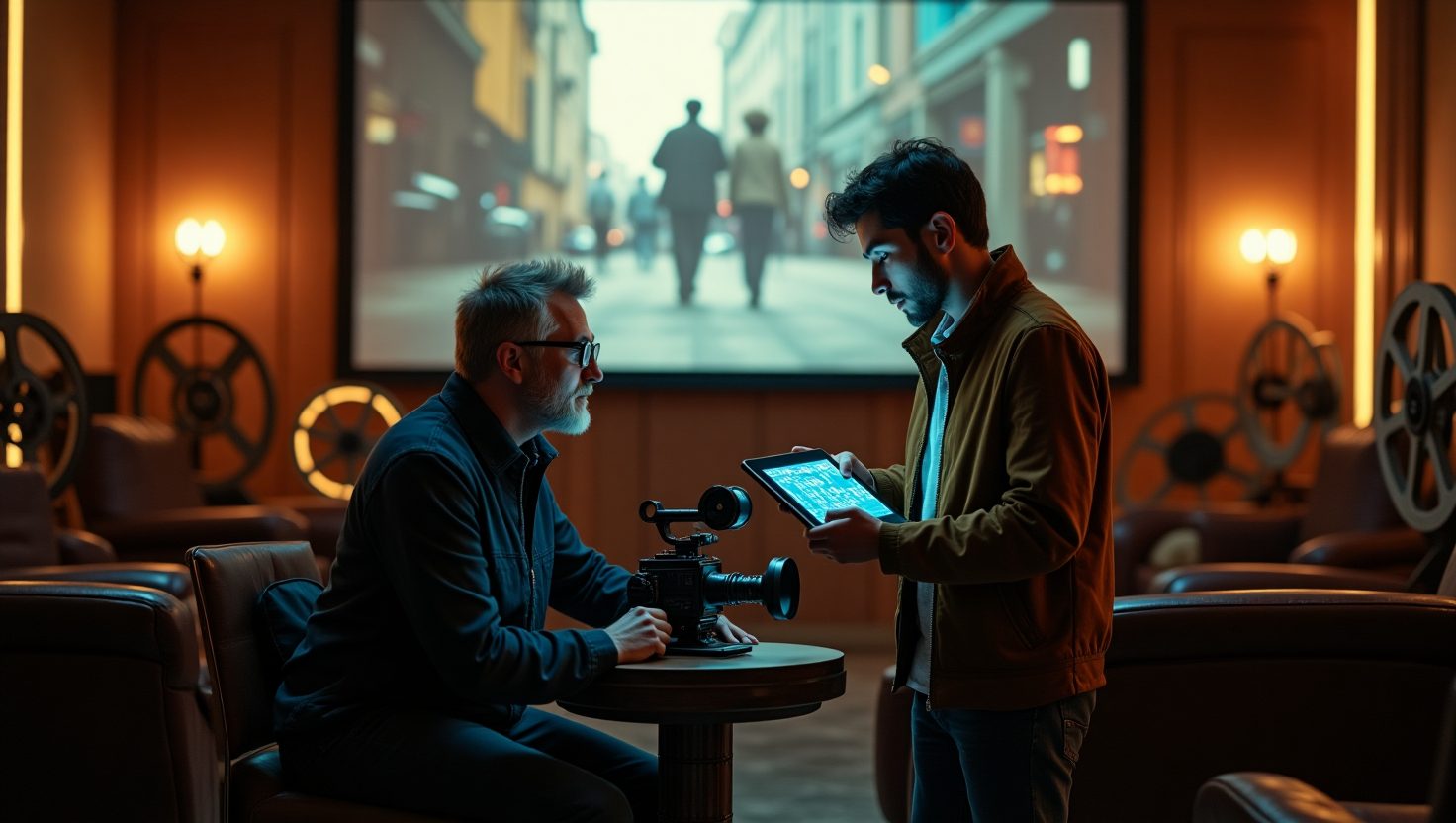
AI Resurrection: Are We Saving Cinema or Creating Digital Zombies?
Hollywood has always loved a good ghost story. But what happens when the ghosts are summoned not by a medium, but by an algorithm? We’re standing at a fascinating, and frankly, quite troubling crossroads where technology is offering to resurrect lost art. The flashpoint for this debate is a project aiming to reconstruct a long-lost version of an Orson Welles classic using generative AI. This isn’t just about cleaning up a bit of film grain; this is about teaching a machine to dream like a dead genius. The entire affair has ignited a fierce debate about AI film restoration ethics, forcing us to ask a rather uncomfortable question: where does preservation end and digital grave-robbing begin?
The Siren Song of Perfect Preservation
On paper, the promise of AI in digital preservation is a cinephile’s dream come true. For decades, archivists have painstakingly worked to save our cinematic history from the clutches of decay. AI accelerates this process exponentially. It can remove scratches, stabilise shaky footage, and even sharpen images with a precision that was once unthinkable. Think of it as a digital fountain of youth for ageing films, restoring them to a state of crispness their own creators never saw.
This technology has already worked wonders on projects like Peter Jackson’s They Shall Not Grow Old, which brought First World War footage to life in breathtaking colour. But now, we’re taking a giant leap into the unknown. We’re moving from restoration to outright re-creation. The new frontier is using AI to generate scenes that no longer exist, based on scripts, still photos, and a whole lot of algorithmic guesswork. And that’s where the utopian dream starts to look a bit more like a Frankenstein-esque nightmare.
Whose Art Is It Anyway?
The core of the issue boils down to a fundamental conflict: the sanctity of director intent versus the allure of technological power. A film is a product of its time, its budget, its happy accidents, and its director’s singular vision. When a director dies, does their work become public domain for any tech bro with a powerful GPU to “fix”?
Melissa Galt, daughter of actress Anne Baxter who starred in The Magnificent Ambersons, articulated this perfectly when speaking to TechCrunch about the project. She argued that an AI-generated version is not the original truth, but “a creation of someone else’s truth.” This hits the nail on the head. An AI can analyse every frame of Welles’s work, but it can never replicate the spark of genius, the pressure of a studio deadline, or the collaborative energy on a 1940s film set. Altering this isn’t just a technical exercise; it’s a retroactive edit of our cultural heritage.
The Ghost in the Ambersons Machine
Let’s get specific. The project causing all this fuss is the brainchild of Edward Saatchi, founder of the AI startup Fable. He aims to recreate the 43 minutes of footage that RKO Pictures notoriously butchered from Orson Welles’s 1942 masterpiece, The Magnificent Ambersons. The studio hacked away at the film, shot a new, jarringly upbeat ending, and allegedly destroyed the original footage. For film lovers, this is one of history’s great “what ifs.” Saatchi calls it “the holy grail of lost cinema.”
His team is feeding generative AI with the original script, surviving stills, and the remaining film to “re-shoot” the lost scenes. The project has even received cautious support from Welles’s own daughter, Beatrice Welles, which lends it a veneer of legitimacy. But many critics and film purists are appalled. They argue that no matter how sophisticated the technology, the result will be a soulless facsimile. It’s less a restoration and more of a high-tech fan-fiction project that trades artistic truth for a technological novelty.
The Two-Headed Actor Problem
Even if you set the philosophical debates aside, there are sobering technical hurdles. As detailed in a follow-up piece by TechCrunch, the process is far from perfect. The AI has apparently struggled, at times generating bizarre artefacts like “two-headed” versions of actors. This is a crucial tell. The AI isn’t understanding cinematography or performance; it’s a hyper-advanced mimic, a parrot reciting Shakespeare. It can reproduce the patterns, but it doesn’t grasp the poetry.
These errors reveal the profound gap between imitation and creation. An AI can’t replicate the subtle lighting choices of cinematographer Stanley Cortez or the nuanced performances Welles coaxed from his actors. It can only produce a statistical approximation. Relying on this flawed tool to complete a masterwork fundamentally undermines creative integrity. What you get isn’t the lost Welles film; it’s a different film entirely, one directed by an algorithm.
Finding the Balance Between Innovation and Integrity
So, should we ban AI from film archives altogether? Of course not. That would be a Luddite’s folly. The technology’s potential for genuine restoration—cleaning, sharpening, and preserving what is there—is immense. The danger lies in crossing the line from enhancement to authorship.
The path forward demands a new set of ethical guardrails. We need a clear distinction between restoration and re-creation. Any AI-generated footage should be explicitly labelled as such, preventing it from being confused with the original artefact. Think of it like a museum displaying a replica of a lost statue. The replica has value as an educational tool, but no one pretends it’s the original Michelangelo. We must approach our cinematic cultural heritage with the same reverence and intellectual honesty.
The conversation around AI film restoration ethics is ultimately a debate about our relationship with art and loss. Some things, once gone, should remain lost. Their absence tells a story in itself—a story of studio interference, of artistic compromise, of the brutal realities of the creative process. By using AI to paper over these historical cracks, we risk creating a sanitised, artificial version of history. We have the technology to play God with our greatest artistic achievements. The only question is: should we? And when the ghost in the machine starts directing the film, who is the real author anyway? What do you think?



