

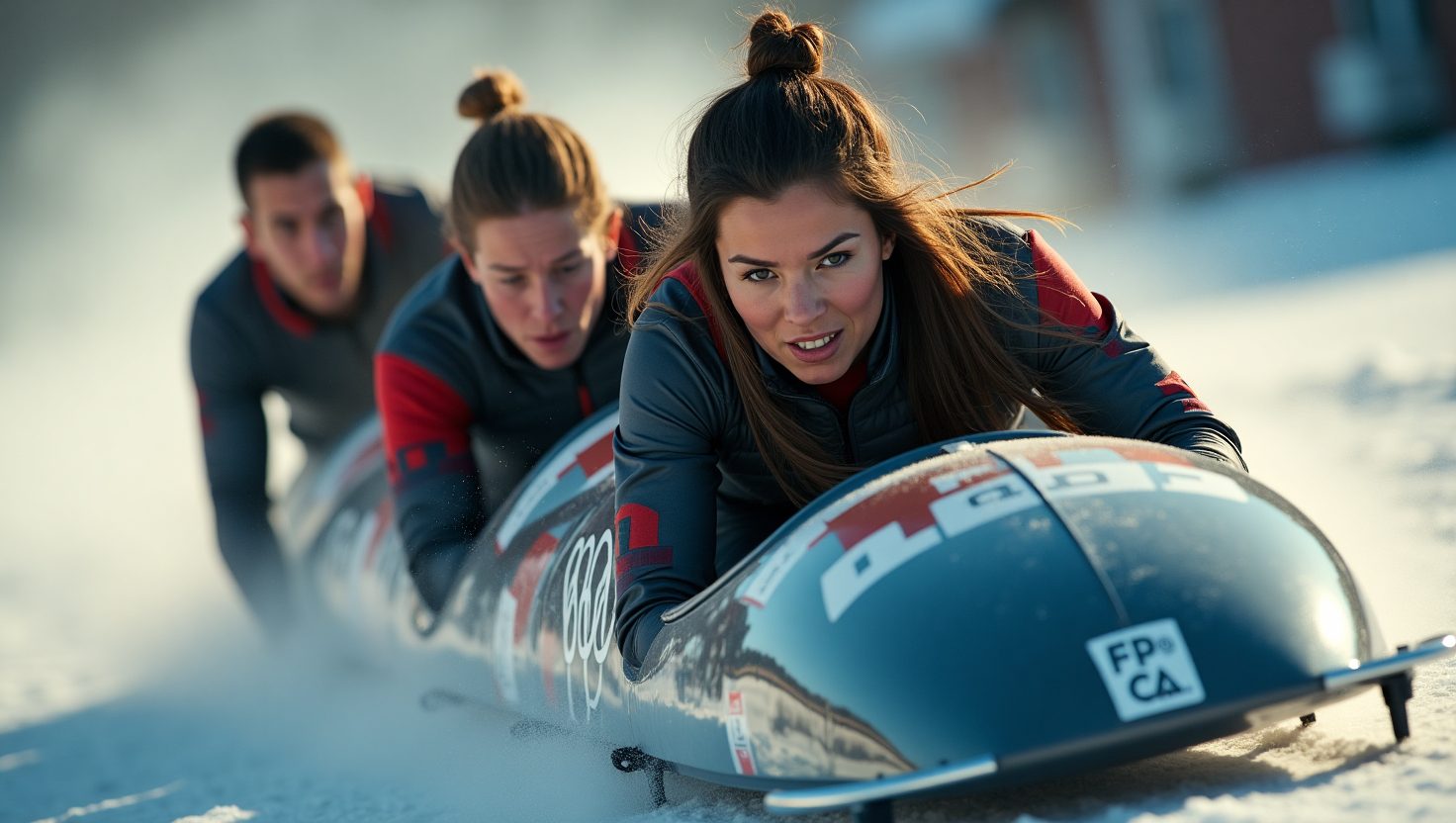
When you picture the Winter Olympics, what comes to mind? Probably the spray of snow from a skier’s turn, the blur of a speedskater rounding a corner, or the brute force of a bobsled team pushing off. It’s a vision of pure human grit, power, and dedication. But behind the scenes, another force is at play, one that’s invisible, silent, and powered by algorithms. For Team USA, this secret weapon is AI sports performance, and it’s fundamentally rewriting the playbook for success.
So, let’s be clear. This isn’t about robots on skates. It’s about something far more subtle and powerful. It’s about turning intuition into data and data into a competitive edge. For decades, elite sport has been a game of inches and milliseconds. Now, it’s a game of terabytes. The real contest is shifting from just the ice to the data centres that analyse every single movement, posture, and muscle twitch.
The New Arms Race: Olympic Technology
Technology has always been part of the Olympic story. From the design of fiberglass poles in the pole vault to the evolution of aerodynamic swimsuits, athletes and their teams have always sought a technical advantage. But the current wave of Olympic technology is different. It’s not just about better materials; it’s about better intelligence.
The traditional training cycle involved practice, review by a coach, gut feelings, and perhaps some video playback. It was an art as much as a science. AI injects a heavy dose of science into that formula. It takes the guesswork out of improvement by providing objective, data-driven feedback that a human eye could never hope to see.
Listening to the Body: The Rise of Athlete Biometrics
The raw fuel for this AI engine is data. Specifically, data from the athletes themselves. The field of athlete biometrics is exploding, with sensors becoming small enough and powerful enough to capture every nuance of performance. Imagine a bobsled containing accelerometers and gyroscopes collecting hundreds of data points every second. That’s not a future concept; that’s what Team USA is doing right now.
As Curt Tomasevicz, a former Olympic bobsledder and now the team’s Director of Sport Performance, points out, the accuracy is mind-boggling compared with the past. We’re talking about a leap in precision that’s “thousands and thousands of times” greater. This isn’t just collecting information for the sake of it. It’s about building a digital reflection of the athlete in motion, a trove of data that AI can then decode.
Turning Data into Gold Medals
Having mountains of data is one thing; making sense of it is another entirely. This is where bespoke AI tools come in, creating a bridge between raw numbers and actionable coaching advice. Two standout examples from Team USA are revolutionising how their athletes prepare.
Slippery Fish: A Wind Tunnel in Your Pocket
For speedskaters, aerodynamics are everything. The slightest change in posture—an elbow drifting out, the head held a fraction too high—can be the difference between a podium finish and obscurity. Historically, the only way to test these changes was in a wind tunnel. As U.S. speedskater Emery Lehman explains, this was a colossal expense: “‘We used to have athletes fly out across the country to a wind tunnel, spending all of this time and money'”.
Enter Slippery Fish. It’s an AI-powered app developed for the U.S. speedskating team that functions, as Chief of Sport Performance Shane Domer calls it, as “‘a wind tunnel in your pocket'”. Coaches can now upload photos or videos of a skater on the ice, and the app’s motion capture analytics creates a digital avatar. They can then tweak the avatar’s posture digitally and the AI simulates the aerodynamic consequences in seconds.
Think of it like a character creator in a video game, but instead of changing hairstyles, you’re adjusting shoulder angles to shave milliseconds off a world-record pace. “‘We can now plug changes in posture into this app and see if those tweaks are actually efficient or not’,” Lehman adds. This allows for rapid, iterative training optimization right there on the ice, a feedback loop that used to take months and a small fortune to complete.
Snowflake: Finding the Perfect Push
The U.S. bobsled team faces a similar challenge but with a different dataset. The start of a bobsled race is a moment of controlled chaos, with four athletes trying to push a sled in perfect synchronisation. To dissect this critical phase, the team partnered with the AI data company Snowflake.
Their sleds are now packed with sensors that, according to the NBC News report, capture thousands of data points per second on everything from the position of each athlete to the forces they’re exerting.
The sheer volume of this data would be overwhelming for any human analyst. But Snowflake’s platform can process it almost instantly, identifying subtle patterns in the push sequence that lead to faster starts. Are the athletes in the back pushing a fraction of a second too late? Is one person’s force misaligned? These are the questions the AI an answer between training runs, giving coaches concrete feedback rather than relying on a “feel.”
The Future is Faster and Smarter
What we’re seeing is the new frontier of elite competition. The days of relying solely on innate talent and old-school coaching wisdom are numbered. As Shane Domer notes, “‘I think as we get past these Games, we’re going to use AI more and more'”. The advantage gained by teams who embrace AI sports performance is simply too great to ignore.
This isn’t just a story about the Olympics. It’s a microcosm of a much larger trend. Just as data analytics has reshaped industries from finance to marketing, it is now doing the same for human performance. The tools and techniques being honed by Team USA will inevitably trickle down to collegiate sports, amateur athletics, and even personal fitness apps.
The larger question is, where does this lead? Will every athlete need a data science team to compete? Does this level the playing field by democratising elite analysis, or does it create a new gap between the tech-haves and have-nots? What we can say for certain is that the fusion of human athleticism and artificial intelligence is creating a new breed of competitor: one that is not only stronger and faster, but infinitely smarter.
What are your thoughts on this? Does the use of AI in sports enhance the spirit of competition, or does it detract from the human element? Let me know in the comments below.
—
Curious to learn more about the specific technologies behind Team USA’s new edge? This insightful report from NBC News provides a deeper look into the Slippery Fish and Snowflake projects.



