

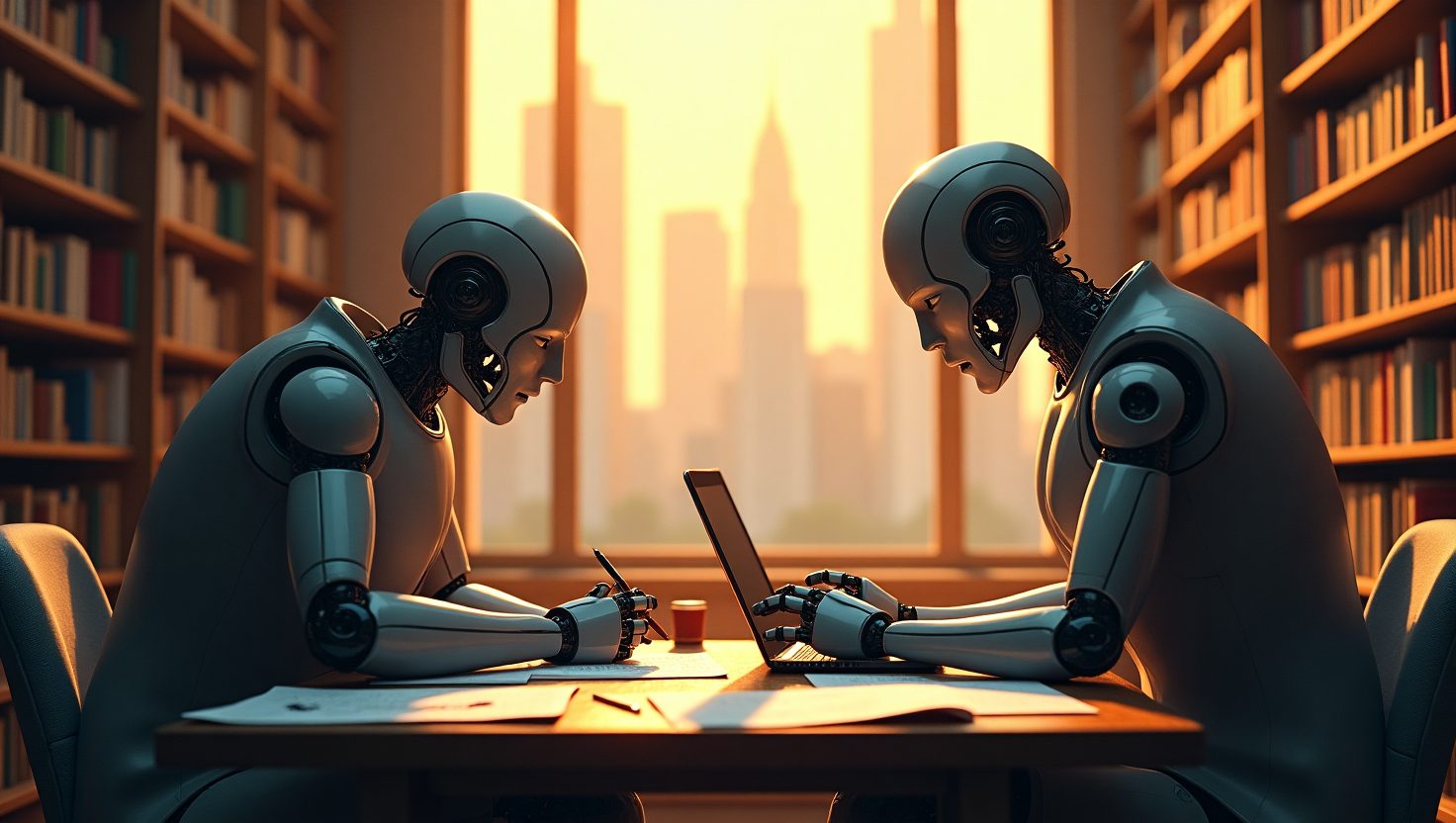
Let’s start with an uncomfortable truth, shall we? What if a machine can write a story you genuinely prefer over one written by a human? Not just a technically competent one, but a piece of fiction that moves you, that you find more compelling, more authentic. It’s a provocative thought, and according to some rather startling research published in The New Yorker, it’s not a hypothetical anymore. This isn’t about whether robots will take over the world; it’s about whether they’re about to take over our bookshelves. And frankly, the early signs suggest a growing AI fiction acceptance that could fundamentally reshape literature as we know it.
So, what happens when the very essence of human creativity – storytelling – can be replicated, and potentially improved, by an algorithm? We need to talk about it.
The Imitation Game Just Got Real
What Exactly Are We Talking About?
When we say ‘AI fiction’, we’re not talking about clunky, nonsensical text anymore. We’re talking about large language models, like OpenAI’s GPT-4o, that have been fine-tuned on an author’s entire body of work. Think of it like a virtuoso musician who has studied every single note a composer has ever written and can now improvise flawlessly in their style.
The technology isn’t new, but its proficiency is. Computer scientist Tuhin Chakrabarty conducted a series of experiments that should send a shiver down the spine of every aspiring novelist. He took the works of acclaimed authors like Junot Díaz and Sigrid Nunez, fed them to an AI, and asked it to generate new passages in their unique voices.
The results? When these AI passages were put up against passages written by graduate creative writing students attempting the same imitation, readers consistently favoured the machine. Chakrabarty noted, “‘They preferred the quality of the A.I. output in almost two-thirds of the cases'”. Let that sink in. The AI wasn’t just passable; it was preferable. The unsettling conclusion is that the line between human and machine prose is blurring to the point of being undetectable, a true challenge to the traditional author-reader dynamics.
Why Are Readers Falling for the Machine?
The Inconvenient Preference
Perhaps the most jarring finding from these experiments is not just that AI can imitate, but that we might like what it produces. In one instance, seven readers failed to correctly identify any of the four human versus AI writing samples. It seems our ability to sniff out the synthetic is far weaker than we’d like to believe.
This isn’t just a lab experiment. There’s already evidence that AI is creeping into the literary marketplace, with some reports suggesting that ‘almost a fifth of recently self-published genre books included A.I.-generated text’.
This points towards a significant shift in the storytelling evolution. Is it possible that what readers truly want is not the soul of an artist but a perfectly engineered product? Sam Altman of OpenAI hinted at this when he described AI as offering “a new way to interact with a cluster of ideas that is better than a book for most things”. It’s a brutally utilitarian view of literature, reducing it from a vessel of human connection to an efficient information delivery system. Are our beloved novels just glorified ‘clusters of ideas’?
The Changing Face of Authenticity
This entire situation forces us to question what ‘authentic’ even means in literature. For centuries, a story’s value was tied to the author’s unique perspective, their lived experience poured onto the page. Joan Didion famously said, “I write entirely to find out what I’m thinking…what I see and what it means.”
But if an AI can generate a passage that readers find more evocative, does the origin even matter? The author-reader dynamics have always been a sort of pact, a trust that the voice we’re hearing is human. AI breaks that pact. The author is no longer a singular creator but potentially a curator, an editor, or merely a prompt engineer for a machine.
A Disruption Centuries in the Making
It’s Always Been About the Money
Let’s not be naive. The history of literature is also a history of technology and economics. As Guido Mazzoni points out in The Theory of the Novel, the novel itself rose to prominence alongside capitalism and the printing press. It was a format that suited a new, individualistic, literate middle class.
Today, we’re facing another one of those inflection points. The publishing industry, like many others, is under immense economic pressure. The temptation to use AI to cut costs, accelerate production, and churn out content tailored to market trends is immense. This is the real engine behind the literary AI disruption: it’s not just a technological curiosity; it’s a powerful economic incentive. The question for publishers isn’t “is it art?” but “does it sell?”.
The Automation of the Soul
The creative automation impact goes beyond just economics. It strikes at the heart of what it means to be a creative professional. If the core task of writing can be automated, what is the author’s role?
– Prompt Crafter? Is the new literary genius just someone who is very good at asking a machine for a story?
– Brand Manager? Does the author become a public face for a brand, lending their name and style to a stream of AI-generated content?
– Editor-in-Chief? Perhaps the author’s job shifts to sifting through mountains of AI text to find the gold.
This isn’t just about job security; it’s about artistic integrity. If a machine can write a convincing imitation of Han Kang, complete with the haunting line, “Live, please live. Go on living and become my son,” does that diminish the raw, human effort of the original?
Can We Steer This Ship?
Protecting Our Cultural DNA
This is where the conversation has to get bigger than just tech. The post-colonial thinker Ngũgĩ wa Thiong’o argued that “Language carries culture, and culture carries…the entire body of values”. Literature isn’t just entertainment; it’s the carrier of our collective memory, our values, our very identity.
If we outsource its creation to algorithms trained predominantly on existing (and often Western-centric) data, what cultures and values are we reinforcing? What voices are we silencing? An unchecked proliferation of AI-generated text risks homogenising our literary landscape, creating a feedback loop where the future of storytelling is just a remix of its past.
A Framework for the Future
So, what can be done? Sticking our heads in the sand is not an option. Banning it entirely is likely impossible and, frankly, a bit Luddite. The path forward probably lies in collective action and thoughtful regulation. We need a framework that prioritises transparency.
– Clear Labelling: Readers have a right to know if a story was written by a human, an AI, or a combination of both.
– Protecting Authorial DNA: Legal minds like Jane Ginsburg at Columbia are already grappling with how copyright law applies. Can an author’s style—their very literary essence—be protected from being data-mined and replicated without consent or compensation?
– Valuing the Human: We may need to consciously create spaces and awards that celebrate and elevate human-only creation, preserving it as a distinct and valuable art form.
The goal isn’t to stop the storytelling evolution, but to ensure it remains a human-driven process.
The rise in AI fiction acceptance is more than just a passing trend; it’s a fundamental challenge to the value we place on human creativity. The uncomfortable truth may be that we are easily satisfied by a clever imitation, but that doesn’t mean we should be. Authors must now navigate a world where their unique voice can be digitised and replicated. Their new challenge isn’t just to write a great story, but to prove why a human-written story still matters.
And that leaves us with the ultimate question: If you were given two books, one by a human and one by an AI, and you knew the AI one was ‘better’ by every objective metric, which one would you choose to read? And why?



