

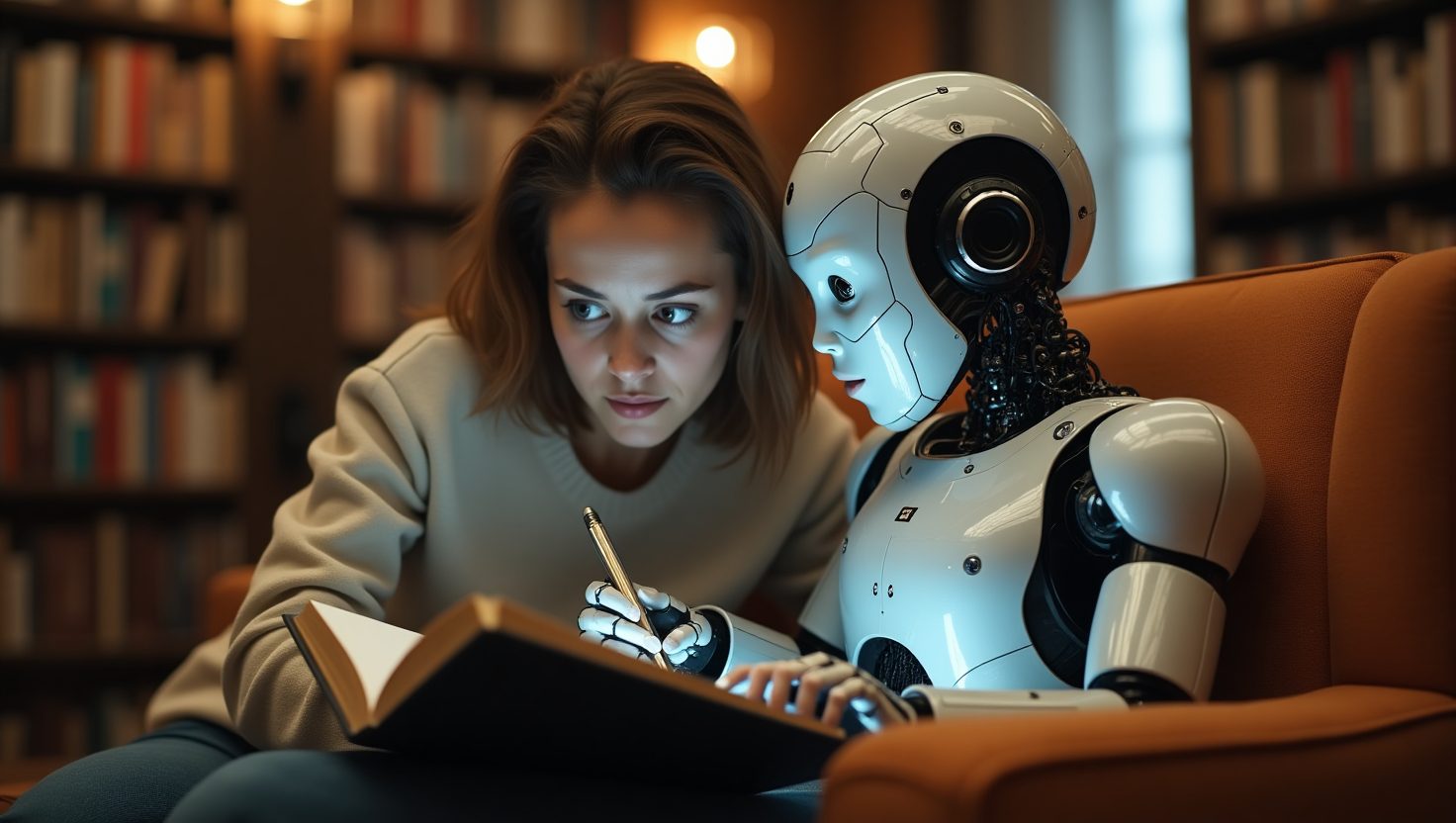
The uncomfortable truth, laid bare in a recent New Yorker article, is that the machines are getting alarmingly good at this. We’re not talking about the clunky, nonsensical text generators of a few years ago. The game has changed entirely.
The AI Apprentice That Never Sleeps
So, how did we get here? It’s all about training. Think of it like a master craftsman and an apprentice. A human apprentice might spend a decade learning their master’s style, absorbing every nuance. An AI model, on the other hand, can be ‘fine-tuned’ by ingesting an author’s entire life’s work—every novel, short story, and essay—in a matter of hours. It doesn’t just mimic the style; it learns the underlying rhythm, the sentence structure, the very soul of the author’s voice.
Researchers Tuhin Chakrabarty and Paramveer Dhillon put this to the test. They trained an AI on the works of authors like Han Kang and Junot Díaz and then pitted its output against passages written by humans imitating those same authors. The results were staggering. In a blind test with graduate students, the AI’s writing was preferred in nearly 65% of cases.
Even more telling, when the author Han Kang was personally tested, she struggled to distinguish between her own prose and the AI’s imitation. Let that sink in. The machine has become such a perfect mimic that the original artist can barely spot the forgery. This isn’t just a party trick; it’s a potential earthquake for the entire literary AI disruption.
Is This the End of Authors as We Know Them?
To understand where we might be heading, it helps to look back. The concept of the solitary author, a genius scribbling away in a garret, is a relatively modern invention. For most of human history, storytelling was a collective act. Think of the epic poems and folk tales passed down through generations. The storytelling evolution has always been in flux.
Now, tech visionaries like OpenAI’s Sam Altman suggest we might be on the cusp of another monumental shift. He envisions a future where literature becomes an “efficient delivery of idea clusters.” Is this what we want? The craft of writing, with all its messy, inefficient, human struggle, reduced to an optimised content delivery system?
This perspective reframes the author-reader dynamics from a relationship built on human connection to a transaction. You have a craving for a certain type of story—a “cluster of ideas”—and the AI serves it up on demand, perfectly tailored to your tastes. It’s the logical conclusion of the Netflix algorithm applied to the written word. Efficient, yes. But is it art?
The Copyright Chaos and the Cultural Void
Beyond the philosophical hand-wringing, there are immediate, messy problems. It’s estimated that as many as 20% of self-published genre books on Kindle already contain AI-generated text, often undisclosed. This creates a Wild West scenario where readers don’t know what they’re buying, and human authors are competing against content farms that can churn out novels in a day.
The tools meant to police this are failing spectacularly. One detection tool, Pangram, was found to miss over 90% of prose from these fine-tuned AI models. The fakes are simply too good. This has led legal scholars like Jane Ginsburg to call for regulations that would ban undisclosed AI use in publishing, protecting the very notion of authorship.
But the most insidious threat might be a cultural one. The Kenyan writer Ngũgĩ wa Thiong’o famously wrote, “Language carries culture… the entire body of values by which we perceive ourselves.” An AI model trained on a vast corpus of text, predominantly from a Western, English-speaking perspective, will inevitably flatten these cultural nuances. It learns the patterns of language but misses the spirit behind it. The creative automation impact isn’t just about jobs; it’s about the potential for a sterile monoculture in our stories.
What Does the Future Hold for Writers and Readers?
So, what happens next? The pact between author and reader is undeniably being rewritten. Perhaps authors will evolve into what some are calling ‘prompt engineers’ or ‘AI curators,’ guiding the machine to produce a final work. In this world, the idea and the vision remain human, but the labour of prose is automated.
Alternatively, we might see the emergence of a ‘proof of human’ movement in literature. Just as we have organic food or artisanal furniture, we might see books proudly labelled “100% Human-Written,” commanding a premium for the perceived authenticity and effort. The brand of the author becomes more important than ever, a stamp of genuine human creativity.
The question of AI fiction acceptance ultimately comes down to what we, as readers, decide to value. Do we value the final product above all else—the perfectly paced plot, the exquisite sentence? Or do we value the story behind the story—the author’s struggle, their unique perspective, the flawed but beautiful humanity baked into the words?
There are no easy answers here. The machines are here, and they are learning to write stories we apparently enjoy. The ball is now in our court.
What do you think? If a book moves you, does it matter if the author has a pulse? Let me know your thoughts below.



