

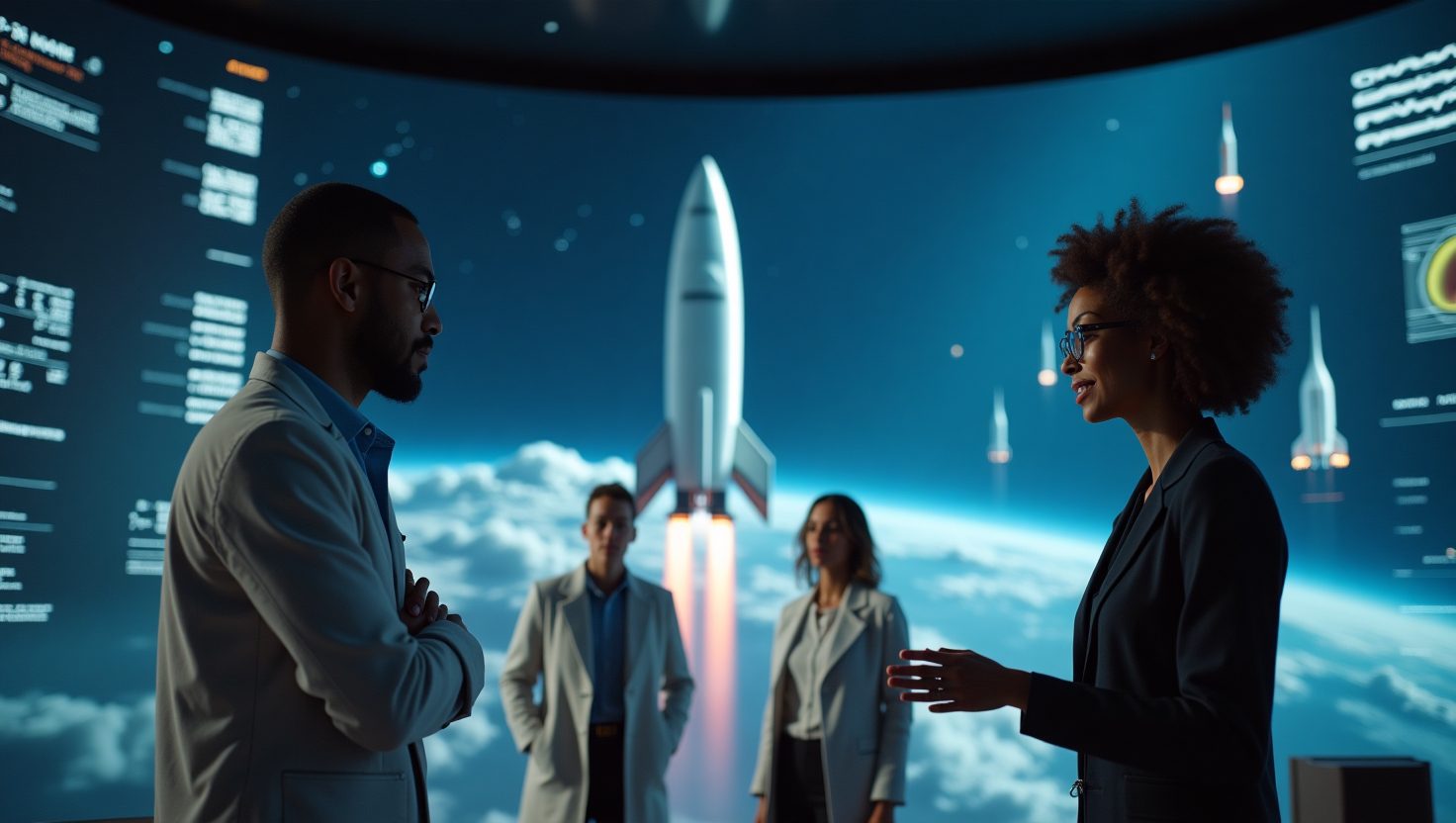
The New Rules of Space Economics
Let’s be clear: the economics of space have always been brutal. Getting a single kilogram of anything into low Earth orbit has historically cost more than its weight in gold. This is the fundamental barrier that aerospace AI is designed to smash. SpaceX, with its reusable rockets, has already rewritten the rulebook on space technology economics. But that was just chapter one.
Think about the sheer complexity of landing a 15-storey rocket booster on a tiny drone ship in the middle of the ocean. It’s not just a pre-programmed flight path. It’s a system making thousands of micro-adjustments per second, responding to wind shear, atmospheric density, and engine thrust. That’s AI in action. Now, Musk is planning to apply that same principle of AI-driven efficiency to everything. The company’s projected revenues of $22-24 billion for next year are built on this foundation of doing the impossibly expensive, cheaply and repeatedly. An IPO raising over $30 billion would pour fuel on a fire that’s already burning white-hot.
Why Autonomous Systems are the Only Way Forward
When we talk about autonomous systems in space, we’re not just talking about fancy autopilots. We’re talking about taking the human out of the loop, not because humans are incapable, but because they are slow, expensive, and fragile. A signal from Earth to Mars can take up to 20 minutes. You can’t joystick a rover out of a sand trap with that kind of lag.
It’s a bit like the difference between a cruise control system and a fully self-driving car. One maintains speed; the other navigates a chaotic city, makes decisions, and learns from its mistakes. The rovers on Mars, the drones flying on Titan, and especially the Starship rockets intended for interplanetary travel must be fully autonomous. They need the intelligence to assess landing sites, manage their own life support, and conduct repairs without a support call back to Houston. Every successful autonomous manoeuvre is a victory against the colossal expense and risk of mission failure.
Finding the Perfect Moment with Launch Optimization
Have you ever wondered why space missions have such specific launch “windows”? It’s a celestial ballet, a fiendishly complex calculation involving Earth’s rotation, the target’s orbit, weather patterns, and the rocket’s performance. For decades, this was the domain of rooms full of mathematicians. Today, it’s a perfect problem for an AI.
This is the core of launch optimization. AI algorithms can process trillions of data points to identify the most fuel-efficient trajectory and the safest possible launch time, far beyond human capability. For a company like SpaceX, which aims to launch dozens, if not hundreds, of missions a year, this isn’t a luxury; it’s a logistical necessity. Optimising a single launch might save a few million in fuel and operational costs. Across a fleet of thousands of satellites, those savings multiply into the billions needed for grander projects.
Satellite AI: The Brain in the Sky
Here is where the story takes a turn. For most, Starlink is a space-based internet provider. For Musk, that’s just its day job. The new, grand vision is to use Starlink’s architecture to build a colossal, orbiting network of data centres. This is the frontier of satellite AI.
According to the WIRED exposé, Musk’s other company, xAI, is desperately hungry for the computational power needed to train its next-generation artificial intelligence models. There simply aren’t enough GPUs and power on Earth to satisfy his ambitions. His solution? Build the data centres in space, powered by the sun and cooled by the vacuum. He tweeted that this new architecture could scale to “>100TW/year of AI,” an astronomical figure that points towards his goal of building a “Kardashev II civilization”—a society capable of harnessing the entire energy output of its star. It may sound like science fiction, but it’s the strategic driver behind a $1.5 trillion valuation.
The Real Reason for the IPO
This brings us to the heart of the matter. Why go public now? Abhi Tripathi of UC Berkeley’s Space Sciences Laboratory, quoted in the same article, puts it perfectly. The moment Musk realised the sheer scale of the AI computation he needed, and that it couldn’t be built on Earth, “that is the moment an IPO suddenly came into play after being unlikely for so long.”
The IPO isn’t for Mars, not directly. It’s to fund the AI infrastructure. The plan is breathtakingly ambitious:
– Use IPO funds to rapidly develop and deploy thousands of modified Starlink satellites that function as data centres.
– Generate revenue by leasing out this immense computational power.
– Eventually, establish satellite factories on the Moon, using electromagnetic railguns to launch them into orbit, further slashing launch costs.
Essentially, Musk is building a utility company in space to fund his other ventures. He’s creating the picks and shovels for the AI gold rush, except the mine is in orbit. The IPO is for the investors who want a piece of that business, not necessarily the ones dreaming of red sand.
So, What About Mars?
Does this mean the Martian dream is dead? Far from it. This AI-centric pivot is arguably the only realistic path to achieving it. The figures associated with establishing a self-sustaining Martian settlement are staggering: an estimated 1 million tons of supplies, requiring 10,000 launches of the colossal Starship, at a total cost that could approach $1 trillion.
That undertaking is impossible without two things: a truly immense source of funding and extremely advanced robotics and AI. The revenue from the space-based data centres could provide the former. The aerospace AI developed to run that network and the autonomous robots needed to build lunar factories are the very same technologies required to build and maintain a city on Mars. The AI is not a detour; it’s the vehicle.
This is a strategy of staggering scale, connecting the immediate demands of the AI industry with the long-term vision of interplanetary colonisation. SpaceX isn’t just a rocket company anymore. It’s aiming to become an integrated space, energy, and intelligence conglomerate. The public offering is simply the financial mechanism to fuse them all together. The question for the rest of the industry is, can anyone else even begin to think on this scale? And what do you think happens when a single company controls both the transport to space and the most powerful intelligence network orbiting the planet?



