

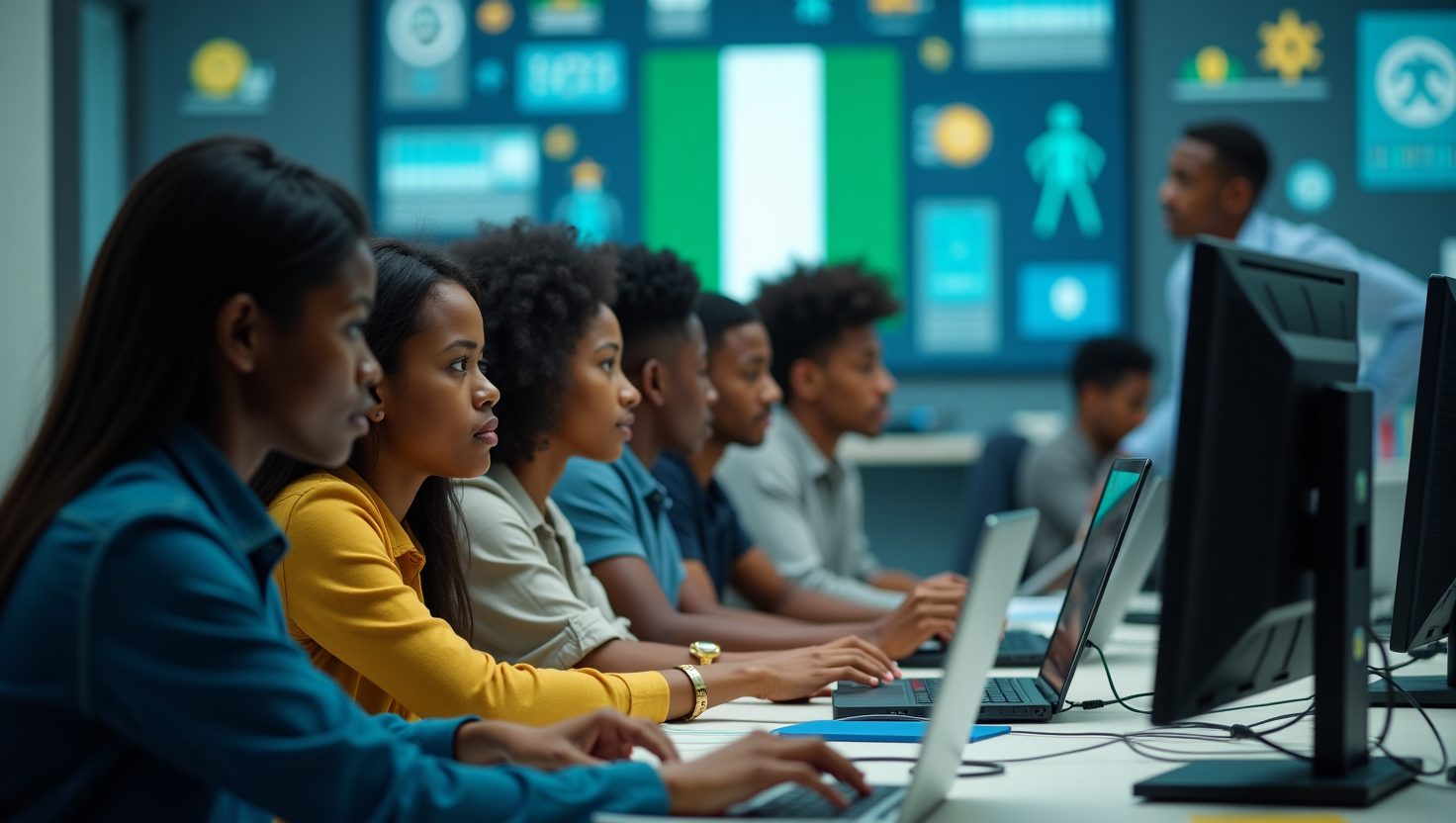
This isn’t just another charitable handout. It’s a small-scale experiment testing a crucial hypothesis: can targeted, practical skills training create a ripple effect big enough to start transforming Nigeria’s economic landscape? When you dig into the details reported by The Nation Online, you see a model that touches upon some of the most critical issues facing the continent today, from staggering youth unemployment to the grand, geopolitical game of digital sovereignty.
Why Sovereignty Starts with a Smartphone
Before we get into the nuts and bolts of the training, let’s talk about that bigger picture. Digital sovereignty sounds like a lofty, academic term, doesn’t it? But it’s brutally simple. It’s about a country controlling its own digital destiny, rather than being a mere consumer—or worse, a digital colony—of American or Chinese tech giants. It’s about who owns your data, who builds your critical infrastructure, and who profits from your digital economy.
Think of it like this: for centuries, countries fought for control over land and physical resources. Today, the battleground is digital. Having citizens who can not only use technology but also build, maintain, and secure it is the modern equivalent of having a skilled workforce and a strong defence force. It’s about self-reliance. When a nation’s digital backbone is built and serviced entirely by foreign entities, is it truly sovereign? That’s a question leaders across Africa are beginning to ask, and the answer is increasingly a nervous “no.”
This is where the push for African AI upskilling becomes less about charity and more about national strategy. By equipping young people with skills in AI, cybersecurity, and even surprisingly fundamental areas like mobile phone repair, you’re building a domestic line of defence. You are creating a generation that can build local solutions for local problems, keeping the economic benefits at home.
Turning the Tide on Youth Unemployment
Now, let’s bring it back down to earth. For millions of young people in Nigeria and across the continent, geopolitical strategy is a distant concern. The immediate crisis is youth unemployment. The statistics are grim, and the social pressure is immense. A university degree no longer guarantees a job, leaving a massive, educated, and frustrated demographic looking for a foothold.
This is where youth unemployment tech solutions come into play, not as a silver bullet, but as a practical ladder. The training programme in Bauchi isn’t just teaching abstract concepts. It is focused on practical, income-generating skills. The inclusion of mobile phone repair alongside AI and cybersecurity is a stroke of genius. Why? Because it’s a tangible skill with immediate market demand. A young person can learn to repair phones and start earning money next week, as beneficiary Ibrahim Khalil from a previous Gombe cohort confirmed, stating the training “enabled him to perform basic repairs in his neighborhood, which now fetches him income.”
This immediate income stream provides the stability needed to then explore more advanced skills in AI or cybersecurity. This creates a pathway—a journey from basic repairman to, potentially, a highly-paid cybersecurity analyst or AI developer. This isn’t just job creation; it’s career creation.
The Power of the Partnership Playbook
So, who pays for all this? The PIP and Mujaddadi programme is a prime example of public-private upskilling, though in this case, it’s a partnership between two private foundations. This model is agile and can often move faster than cumbersome government initiatives. According to the foundations, this is part of a grander vision to train 10,000 youths across the region. They’ve already trained 250 in Gombe State, meaning this isn’t their first rodeo.
The real magic here is in the details of the support provided. Graduates don’t just get a certificate; they get startup kits. This single detail is arguably the most important part of the entire programme. It acknowledges a fundamental truth: skills are useless without the tools to apply them. Giving someone a toolkit or the basic software to start a small business is the bridge between training and earning. It’s the difference between a nice CV entry and actual self-reliance.
This collaborative approach offers several key benefits:
– Practical Focus: Foundations are often more grounded in community needs than government bodies might be.
– Resource Pooling: Combining funds and expertise allows for more comprehensive programmes, including those crucial startup kits.
– Scalability: A successful model can be replicated. If this works for 200 youths in Bauchi, it can be adapted for 2,000 elsewhere, attracting more partners along the way.
The Unavoidable Hurdle: Bridging Infrastructure Gaps
Of course, we have to address the elephant in the room: infrastructure gaps. You can’t have a thriving digital economy without reliable electricity and affordable, widespread internet access. This is a massive, systemic challenge that a single training programme cannot solve. It’s like teaching someone to be a world-class chef but only giving them a campfire to cook on.
So, is the training pointless? Not at all. It’s about being pragmatic.
– The focus on mobile phone repair, for instance, is less dependent on constant connectivity.
– Providing startup kits can include offline resources or tools that mitigate the need for perfect infrastructure from day one.
– Most importantly, creating a cohort of tech-savvy individuals creates grassroots demand for better infrastructure. When thousands of small businesses are hampered by poor connectivity, they become a powerful lobbying force for change.
The long-term solution requires massive government and private sector investment in fibre optic cables, stable power grids, and data centres. But in the meantime, these ground-up initiatives build the human capital, ensuring that when the infrastructure does improve, there is a skilled workforce ready and waiting to exploit it.
A Gamble Worth Taking
So, back to our initial question. Can training 200 youths change a nation? No. But can it prove a model that, if scaled, could make a significant dent in youth unemployment and strengthen digital sovereignty? Absolutely. The Pantami and Mujaddadi foundations, as detailed in The Nation Online, are not just offering training; they are planting seeds. They are betting that by giving young people the right skills and the right tools, they can start a chain reaction of local innovation and economic empowerment.
This is the kind of African AI upskilling that matters. It’s practical, it’s scalable, and it’s strategic. It understands that a digital economy is built not just by titans in capital cities, but by thousands of small entrepreneurs in towns like Bauchi. This is a quiet revolution, happening one repaired phone and one secure network at a time. The real question isn’t whether it will work, but whether there’s the will to fund and scale it ten-thousand-fold.
What do you think? Are these small-scale, targeted initiatives the most effective way forward, or is the focus better placed on top-down, national infrastructure projects first?



