

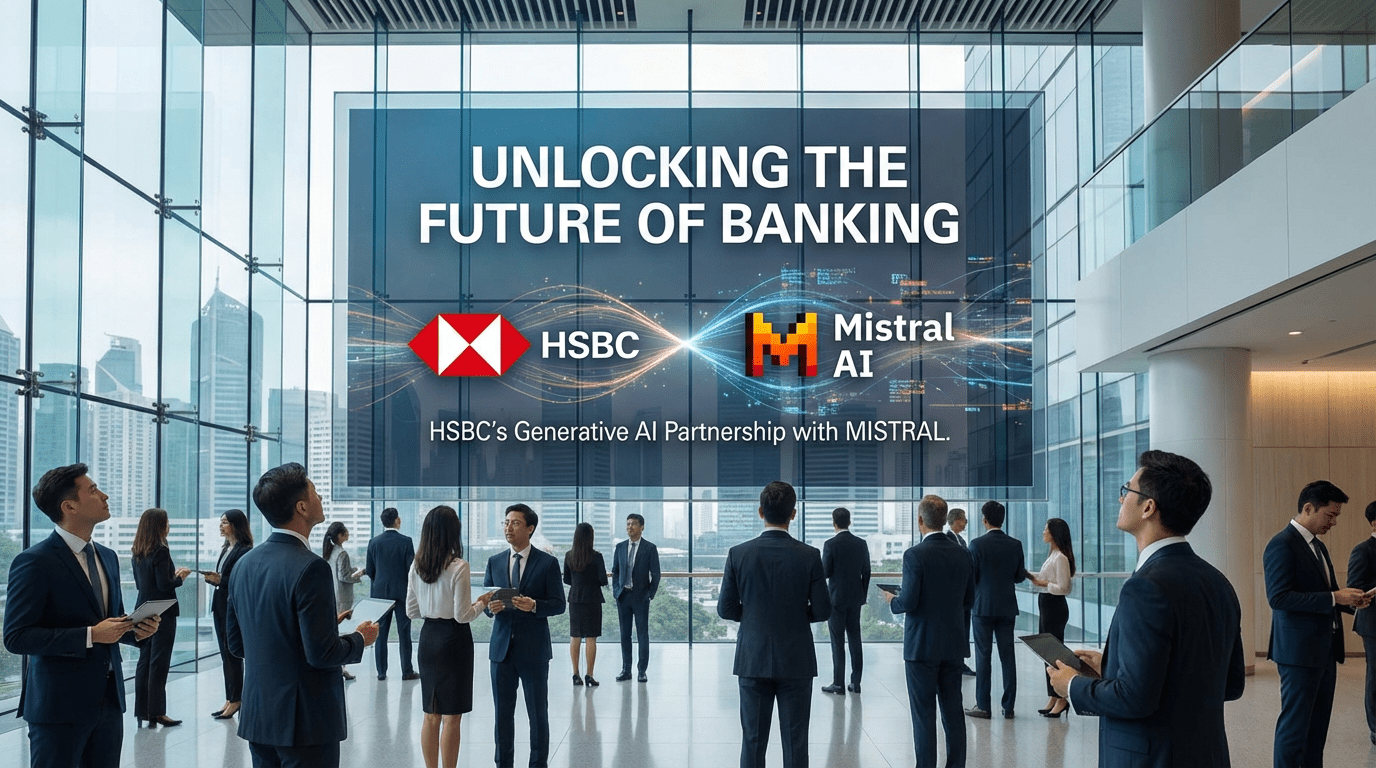
So, HSBC is pairing up with Mistral AI. On the surface, it’s another press release about a legacy giant cosying up to a hot AI startup. But if you look closer, this isn’t just about a bank trying to look innovative. This multi-year deal is a deliberate, strategic move that provides a fascinating blueprint for the future of banking generative AI, and it’s a story about plumbing as much as it is about flashy new features. Let’s unpack what’s really going on here.
For years, AI in banking has been a bit like a well-behaved but slightly dim assistant, good for basic fraud detection and sorting customers into queues. It was useful, but not exactly revolutionary. Generative AI is a different beast entirely. It’s the difference between an assistant who can file documents and one who can actually help you write the report. We’re moving from automation to augmentation, and banks, with their mountains of data and armies of analysts, are ground zero for this shift.
What Is This Thing Called Banking Generative AI?
At its core, banking generative AI uses large language models—the same technology behind tools like ChatGPT—to create new content. This could be anything from drafting emails to customers, summarising complex financial reports, or even writing code to automate internal processes. It’s about generating value from the vast lakes of information that banks are sitting on.
The partnership between HSBC and France’s Mistral AI, as detailed in their own announcement, is a clear signal of intent. This isn’t a tentative experiment. It’s a deep integration aimed at overhauling fundamental banking operations. Georges Elhedery, HSBC’s Group CEO, called it “an exciting step forward in HSBC’s technology strategy”, and for once, that sort of corporate speak actually holds weight. They are not just buying a product; they are building a capability.
Conversation is the New Interface
One of the most immediate applications is in conversational banking. We’ve all suffered through infuriatingly stupid chatbots that can only handle three preset questions. The promise here is for something far more sophisticated. Imagine a banking app where you can simply ask, “What was my biggest expense category last month, and how does it compare to the previous year?” and get an instant, coherent answer with a breakdown.
This isn’t just about customer service. Internally, think about relationship managers who need to prepare for a client meeting. Instead of spending hours digging through reports, they could ask an internal AI assistant to summarise a client’s entire history, recent market changes relevant to their portfolio, and even draft a personalised follow-up email. This improves the customer experience by making the human banker more effective, not by replacing them.
The Unsexy but Crucial World of Compliance
Here’s the part that rarely makes headlines but is arguably the most valuable application for a global bank: regulatory compliance AI. Big banks operate across dozens of jurisdictions, each with its own labyrinthine set of rules. Staying compliant is a colossal operational headache and a massive cost centre. A single mistake can lead to eye-watering fines.
Think of generative AI here as hiring an army of eternally vigilant, hyper-fast paralegals. It can scan thousands of pages of new regulations, cross-reference them with a bank’s internal policies, and flag potential conflicts or areas that need updating in minutes, not months. This transforms compliance from a reactive, manual slog into a proactive, automated process. It’s the defensive play that makes all the offensive, customer-facing innovations possible. You can’t build a fancy new roof if your foundation is cracked.
HSBC and Mistral: A Practical Case Study
So what are HSBC and Mistral actually planning to do? According to their joint statement, the initial focus is on improving internal processes. This is smart. Before you let a new AI talk directly to your customers, you test it internally where the stakes are lower. The announced applications include:
– Tailored Communications: Helping bankers draft more personalised and relevant messages to clients.
– Financial Analysis: Automating the summarisation of reports and identification of key insights.
– Multilingual Services: Leveraging Mistral’s models to better serve a global client base in their native language.
Arthur Mensch, Mistral AI’s CEO, noted their models will “reinvent HSBC’s workflows”. The keyword is workflows. This is about financial service automation at a fundamental level. It’s about making every employee who deals with information more productive. Future plans mentioned in the HSBC news release will touch on more direct client applications, including credit processes and fraud detection, but the strategy is clear: fix the inside first.
Building AI You Can Actually Trust
Of course, letting powerful AI loose inside a bank comes with enormous risks. What if it “hallucinates” and gives a client incorrect financial advice? What if it inherits hidden biases from the data it was trained on? A bad recommendation from an e-commerce site is annoying; a bad recommendation from a bank could be life-altering.
This is why both companies are stressing their commitment to “responsible AI”. For Mistral, this means providing models that are more customisable and transparent than some of their larger rivals. For HSBC, it means establishing strict governance and testing frameworks. They are not just plugging in an API and hoping for the best. They are building a secure, private environment where they can fine-tune and control the AI’s behaviour before it interacts with sensitive data or customers.
The New Competitive Battleground in Finance
Looking ahead, this partnership feels less like a one-off deal and more like the starting gun for the rest of the industry. For years, the big tech cloud providers—Amazon, Google, Microsoft—have been the primary AI partners for enterprise. The HSBC-Mistral deal shows a potential shift towards banks partnering with more specialised, and perhaps more neutral, AI firms.
The question is no longer if banks will adopt banking generative AI, but how and with whom. Will they build their own models, partner with the tech giants, or follow HSBC’s lead with more focused players like Mistral? This choice will define their technological independence, their cost structure, and their ability to innovate for the next decade. The banks that get this right will build a significant competitive moat. Those that get it wrong will be left struggling with legacy systems and an ever-widening productivity gap.
This is the real story of the HSBC-Mistral partnership. It’s a case study in how a legacy institution is trying to navigate a monumental technological shift. It’s about strategy, risk management, and the future of financial plumbing.
What do you think? Is this partnership a genuinely transformative move, or is it just a very expensive R&D project? Which bank will be next? The race is on, and it’s going to be fascinating to watch.



