

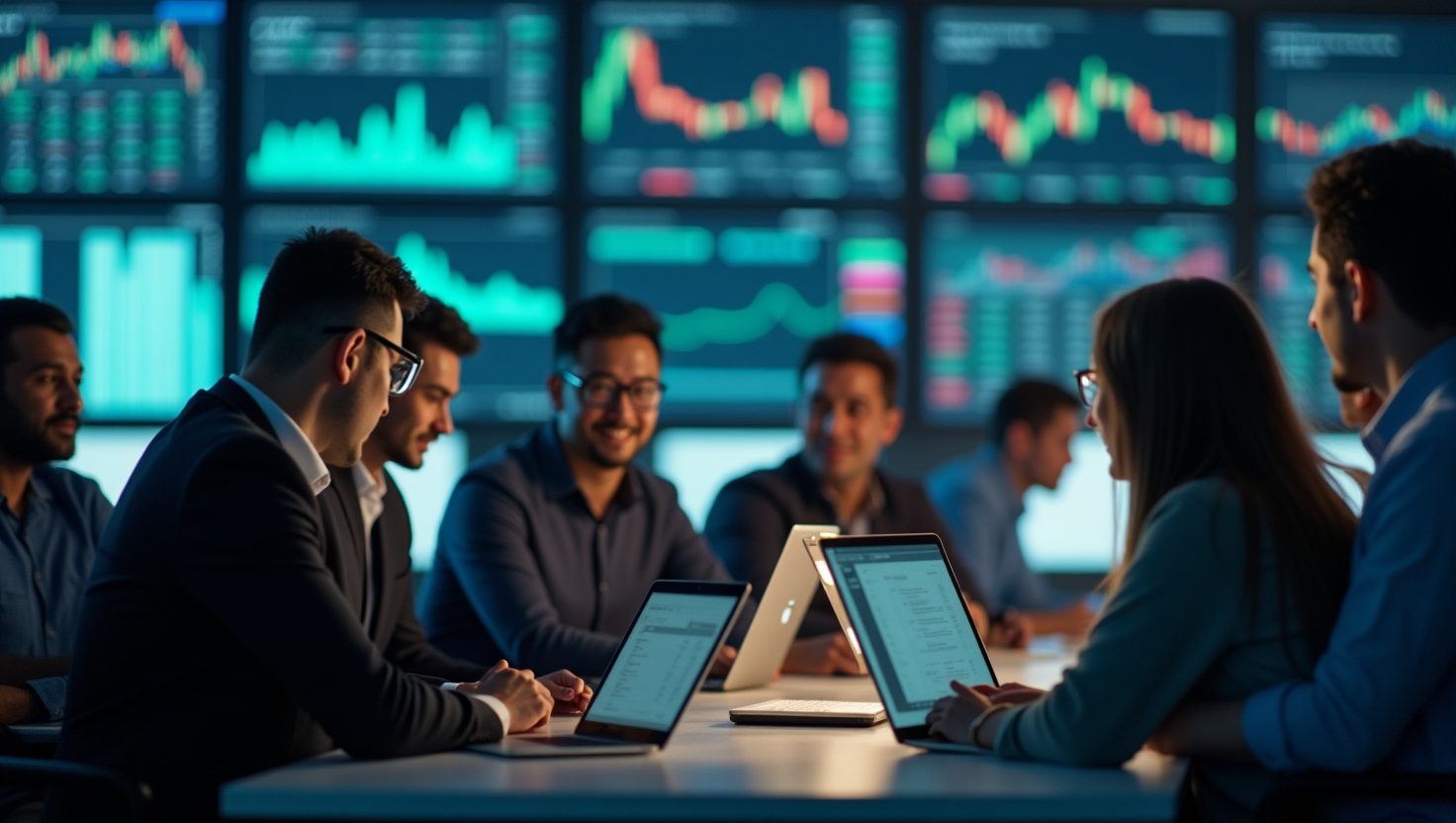
You see the headlines everywhere. AI is eating the world, and Wall Street is its main course. Hedge funds, we’re told, are in an arms race, throwing billions at shiny new AI trading algorithms to get an edge. But is that what’s really happening? Or are we seeing the first frost of a long, cold Quant Winter, where the initial hype cools and the hard realities of the market bite back?
The story everyone wants to sell you is one of inevitable AI dominance. Firms like Citadel and Balyasny are indeed pouring resources into it. As detailed in a recent Business Insider piece, Balyasny has around 80% of its staff using internal AI tools, processing mountains of data to find an advantage. Point72 has even spun up a dedicated AI fund, Turion, which reportedly outperformed its human-run flagship. On the surface, it looks like the machines have already won. But talk to the people who actually run these multi-billion-pound empires, and a different, more sceptical picture emerges.
The Siren Call of the Algorithm
Let’s be clear. AI trading algorithms aren’t new. For years, quants have used machine learning to find patterns invisible to the human eye. The difference now is the sheer scale and the type of data being used. We’ve moved beyond simple price and volume.
The new game is all about alternative data. Think satellite images of supermarket car parks, credit card transaction data, or even the sentiment of millions of social media posts. The goal is to know what’s going to happen before anyone else. As Citadel’s CTO, Umesh Subramanian, put it, “It’s an arms race to be able to consume the right kind of data.”
This is where AI is supposed to shine. No human team can possibly sift through petabytes of unstructured data. So, you build a model, feed it the data, and let it find the golden correlations. Simple, right?
The Data Deluge and a Fatigue of Facts
Here’s the first crack in the facade: alternative data fatigue. Just because you can analyse everything doesn’t mean you should. The market is a ridiculously noisy place. For every genuine signal hidden in that satellite imagery, there are a thousand false positives.
It’s like trying to find a specific grain of sand on a beach by weighing the entire beach. An AI might find a correlation between a specific company’s stock price and the number of blue cars in its car park on a Tuesday. Is that a genuine insight or just statistical nonsense? The risk is that these algorithms, brilliant as they are, end up chasing ghosts in the data, optimising for randomness. The sheer volume of information creates a new kind of fog, and funds are beginning to question if the cost of navigating it is worth the occasional, questionable insight.
When Market Volatility Breaks the Model
This brings us to market volatility models. A key promise of AI is its ability to predict and navigate choppy waters. The models are trained on historical data, learning how assets behaved during past crises. But what happens when the next crisis looks nothing like the last one?
AI models are fundamentally backward-looking. They are exceptionally good at finding patterns in the data they’ve seen, but they have no real-world understanding or common sense. A global pandemic, a sudden war, or a bizarre meme-stock frenzy driven by a Reddit forum—these are black swan events that break the models. In these moments, you don’t need a machine that can calculate probabilities based on the past; you need a human who can understand fear, greed, and a narrative that has never existed before.
The AI might be the world’s best co-pilot in clear skies, but when the engines fail over the mountains, you still want a seasoned human captain in the cockpit.
The Problem with the Black Box
This points to the biggest hurdle for AI on Wall Street: trust. Many of these sophisticated models are effective black boxes. Data goes in, and a trade decision comes out. The ‘why’ is often lost in a web of complex calculations no single person can fully comprehend. This is the world of black box investing.
Are you, as a fund manager, willing to bet billions of your investors’ money on a decision you can’t explain? What do you tell them when the black box gets it spectacularly wrong?
This is precisely the point made by some of the industry’s heaviest hitters. Ken Griffin, the founder of Citadel, has stated flatly that AI “cannot yet beat the markets.” He argues that whilst his firm uses AI extensively for data processing, the ultimate strategic decisions must be human-led. He isn’t betting the farm on an algorithm he can’t question. Similarly, Elliott Management’s Paul Singer has called the supposed use cases for AI “way exaggerated,” suggesting much of it is marketing fluff.
Even at firms celebrating their AI wins, there’s a caveat. Man Group, a pioneer in quant trading, noted that its own advanced model, AlphaGPT, “still requires human oversight and strategic direction.” Their executives concluded that the AI doesn’t replace human judgement but “amplifies it.”
The Future is Augmentation, Not Abdication
So, what does this all mean for the future of AI trading algorithms? The “Quant Winter” isn’t about hedge funds unplugging their servers and going back to paper-tape trading. That’s not going to happen. The AI genie is out of the bottle.
Instead, this is about a flight to quality and a retreat from blind faith. The initial, feverish gold rush is ending, and a more mature, pragmatic era is beginning. The future isn’t a battle of Human vs. Machine. It’s about defining the proper relationship between them.
– AI as the Ultimate Analyst: AI will continue to be an indispensable tool for processing gargantuan data sets. It will act as a team of a million junior analysts, flagging anomalies and suggesting correlations that humans can then investigate.
– Humans as the Strategists: The final call, the strategic overlay, and the understanding of macro-narratives will remain firmly in human hands. People who can ask “why?” will be more valuable than ever.
– A Sceptical Eye on Hype: Funds will become more discerning. The era of buying into “AI” as a magical concept is over. Instead, they will demand specific, provable value from any model, and they will be intensely aware of its limitations.
The true revolution isn’t that machines are taking over Wall Street. The revolution is that the finance industry is finally learning what other tech sectors have known for years: AI is an incredibly powerful tool, but it’s just that—a tool. It has no wisdom, no context, and no skin in the game.
The real alpha, the real edge, won’t be found in the most complex algorithm but in the wisdom of knowing when to trust it and, more importantly, when to turn it off. What do you think? Is the age of the all-powerful trading algorithm already over before it truly began?



