

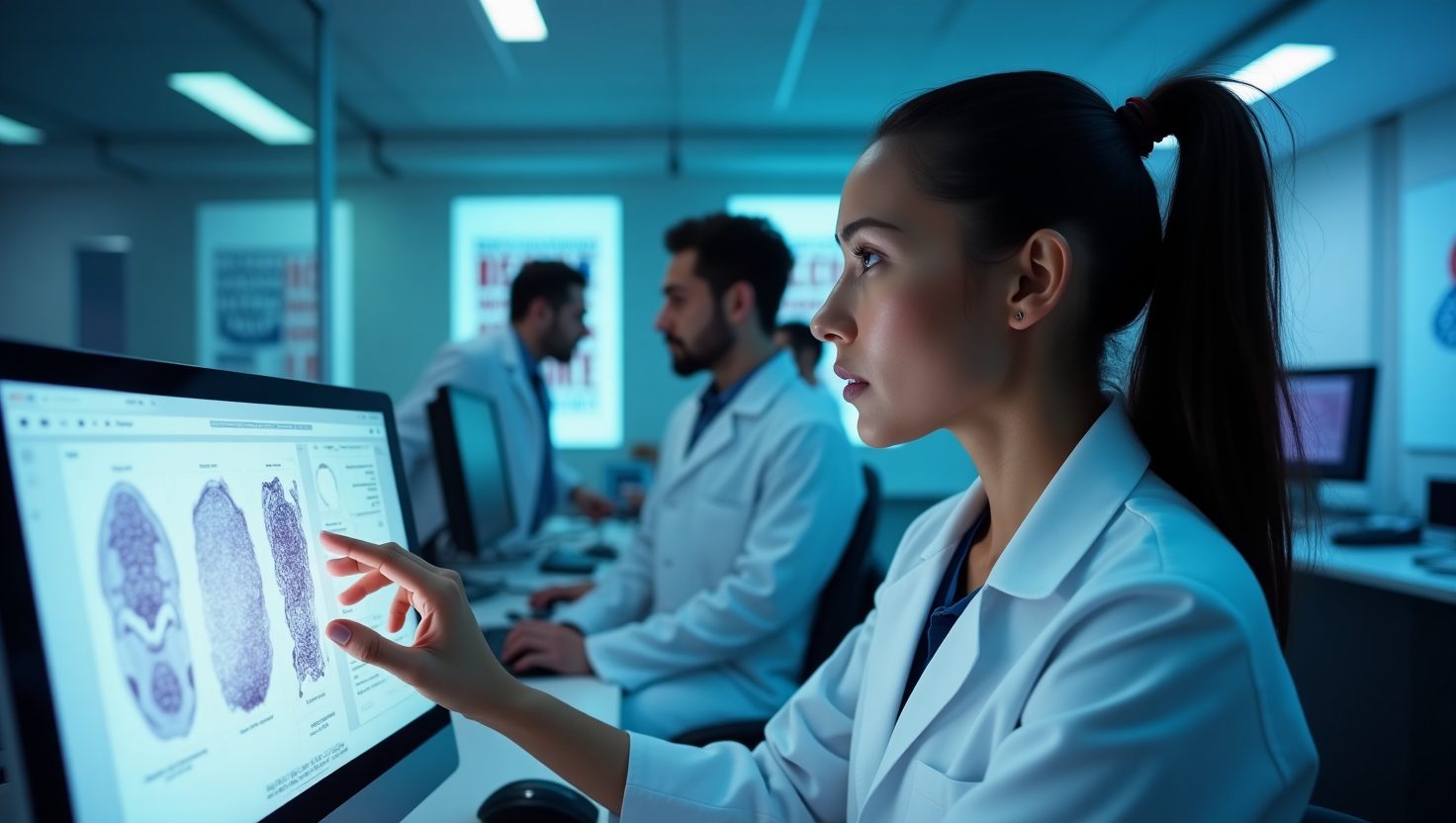
Let’s be honest, when most people think of artificial intelligence, their minds jump to chatbots writing poetry or algorithms deciding which film to recommend next. Yet, the real, and dare I say, more profound, revolution is happening quietly in places far from the public eye – inside pathology labs. The world of medical diagnosis AI is moving from a theoretical curiosity to a clinical powerhouse, and nowhere is this more apparent than in the fight against leukaemia.
We’re seeing claims of near-perfect accuracy from AI models designed to spot cancerous cells. While numbers like 97% or even 100% sound like a definitive victory, the story, as always, is a bit more complicated. Getting this right isn’t just an academic exercise; it’s about life and death, hope and despair. So, what’s really going on behind these headline figures?
The Human Element in a Sea of Cells
Before we get into the silicon, let’s remember the carbon. Leukaemia is a cancer of the body’s blood-forming tissues, a disease where the very system designed to protect us turns against itself. For decades, the gold standard for diagnosis has been a human expert – a haematologist – peering through a microscope at a blood smear. This process of hematology imaging is as much an art as it is a science.
The expert’s trained eye scans for abnormalities in a sea of millions of cells, a task that is incredibly demanding, time-consuming, and, crucially, subjective. One pathologist’s “suspicious” might be another’s “normal.” This variability can lead to devastating consequences, including high false positive rates, where healthy individuals are told they might have cancer, creating immense stress and leading to unnecessary, invasive follow-up procedures. The need for a more objective and efficient system is screamingly obvious.
Enter the Digital Pathologist
This is where pathology automation steps in. AI isn’t about replacing the human expert but about giving them a superpower. Think of the AI as a tireless assistant that can sift through an entire blood smear in seconds, flagging every single cell that looks even remotely out of place. It never gets tired, never has an off day, and can analyse data at a scale no human ever could.
So how does this digital bloodhound work? It’s a remarkably logical process:
– Image Capture: A high-resolution digital image of the blood smear is taken.
– Preprocessing: The AI cleans up the image, adjusting brightness and contrast to make the cells stand out clearly.
– Segmentation: This is the clever bit. The algorithm isolates each individual cell from the background and its neighbours, like digitally cutting out paper dolls.
– Feature Extraction & Classification: The AI analyses the unique features of each cell – its size, shape, texture, and the colour of its nucleus. It then compares these features to the millions of examples it was trained on and makes a call: normal or malignant?
The engine driving this is typically a Convolutional Neural Network (CNN). If you’ve ever used a photo app that can find all the pictures of your cat, you’ve used a CNN. It’s a type of AI brilliant at recognising patterns in images. In this case, instead of looking for whiskers and pointy ears, it’s hunting for the tell-tale signs of a leukaemic blast cell.
As reported in a detailed review by the American Journal of Managed Care, some of the most successful systems are hybrid models, pairing a CNN with a Support Vector Machine (SVM) to fine-tune the classification. This combination is proving brutally effective.
The Problem with Perfection
Now for those headline numbers. The AJMC article, which synthesised results from over 25,000 scientific papers, highlights some truly astonishing figures. In controlled lab settings, models using established architectures like AlexNet have achieved “up to 100% correct classification.” Hybrid systems consistently clock in with accuracy levels “above 97%.”
On the surface, this is a game-changer. An automated system that’s more accurate than a human and works thousands of times faster? It sounds like a solved problem. But this is where the laboratory environment collides with the messy reality of global healthcare. The success of any medical diagnosis AI is entirely dependent on the data it was trained on.
The Real-World Hurdles
The promise of AI in medicine is tempered by a few stark realities. These models, for all their power, are brittle.
First, there’s the data dependency. An AI trained exclusively on blood smears from a hospital in Cambridge might perform brilliantly there. But show it a slide from a clinic in Kampala, where the staining chemicals are different, the microscope slides are from another manufacturer, and the patient population has a different genetic background, and its stellar accuracy can plummet. The model isn’t seeing cells; it’s seeing data patterns. If the patterns change, its performance becomes unpredictable.
This leads to the second major issue: global disparity. The regions that could benefit most from pathology automation—developing nations with a severe shortage of trained haematologists—are often the ones with the least amount of high-quality, digitised data needed to train these systems. There’s a cruel irony in developing a tool for the underprivileged using data only the privileged can provide.
Finally, there are the ethical and regulatory mazes. For a tool to be used in clinical validation, it needs to be approved. But who is liable if a flawless-in-the-lab AI misses a diagnosis in a real patient? Is it the doctor who trusted it? The hospital that bought it? The company that built it? These are the thorny questions regulators, insurers, and lawyers are just beginning to grapple with.
A Tool, Not an Oracle
So, where does this leave us? The future of AI in leukaemia detection isn’t about creating a black box that delivers a simple yes/no answer. As the AJMC review wisely puts it, “the future of AI in leukemia lies not in producing isolated classification accuracies but in providing clinically relevant decision support.”
The real value lies in building systems that act as a partner to the clinician. An AI could not only flag suspicious cells but also provide a probability score, highlight the specific features that are concerning, and even pull up images of similar cases from a global database. It could help predict which type of leukaemia it is, guiding the doctor toward the most effective treatment plan from the very beginning.
To get there, we need a concerted global effort to build diverse, representative datasets. We need open standards for how images are captured and annotated so that a model trained in one country can be reliably validated and used in another. The goal isn’t just a higher accuracy percentage; it’s about making that accuracy accessible to every patient, everywhere.
The journey of medical diagnosis AI from the lab to the clinic is well underway, but we’re still in the early stages. The technology holds incredible promise, but its true success will be measured not by its performance in a controlled trial, but by its ability to navigate the complexities of our global health system.
What do you think is the biggest barrier to integrating these AI tools into your local healthcare system? Is it the technology, the cost, or the trust?



